
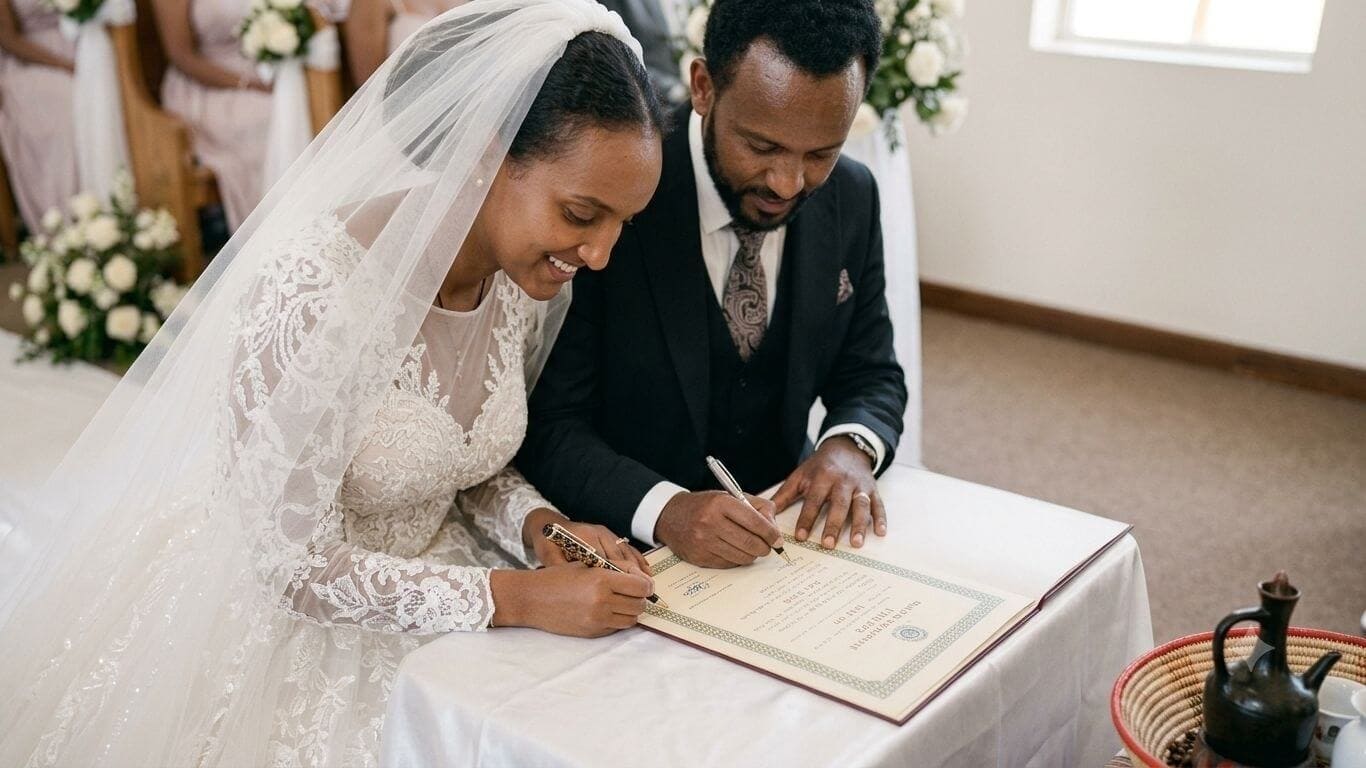
Marriage in Ethiopia is not just a personal agreement; it becomes legally valid only when it meets specific legal requirements. This guide walks through the key requirements.
A couple spends months planning a wedding down to the smallest detail. The venue is chosen for its views, the outfits are carefully picked, and the food is designed to impress every guest. In many cases, the goal is simple: create a ceremony that people will talk about and share online long after the day is over.
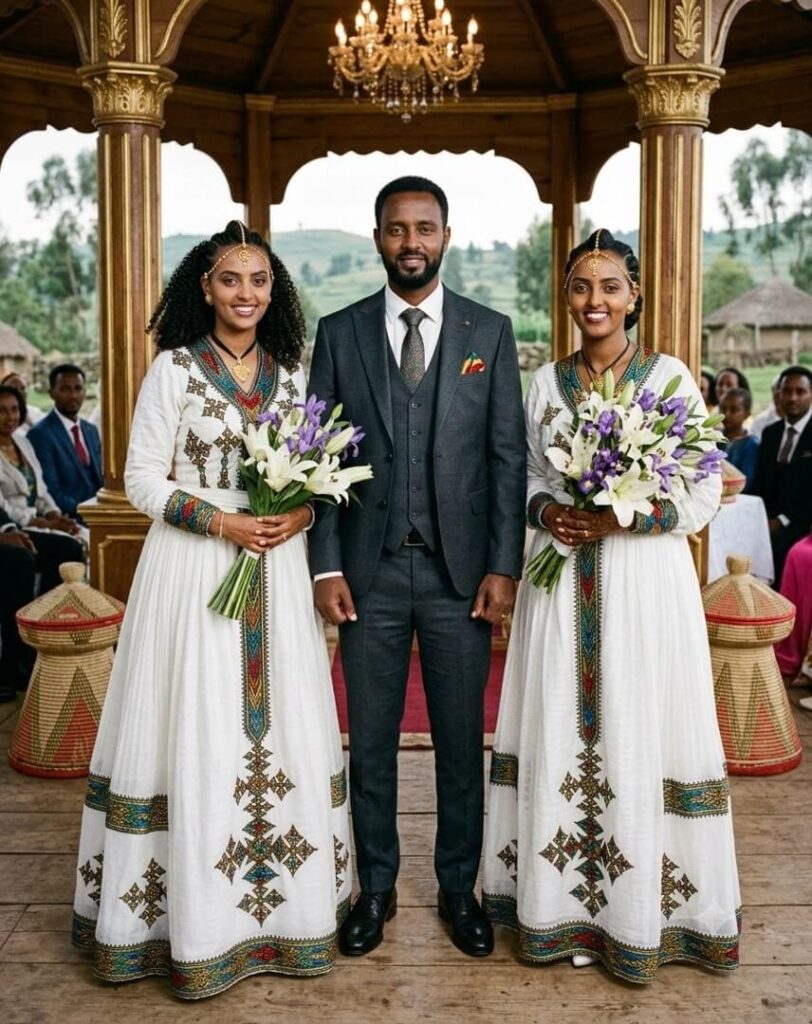
In Ethiopia, weddings often go beyond just the ceremony itself. There are deep cultural moments that shape how families come together, from traditional food and attire to long-standing customs that still carry weight today. Practices like shimagelay, where elders first visit the bride’s family to open discussions, or telosh, where gifts and bride price negotiations take place, are still part of many communities. These traditions are meaningful, but they sit alongside another layer that is just as important.
Here’s where many couples miss something critical. A wedding can look complete, feel complete, and even be celebrated by everyone around but still not be legally recognised. In other words, what happens at the ceremony is not always what the law sees as a valid marriage. That gap between celebration and legal recognition is where problems often begin.
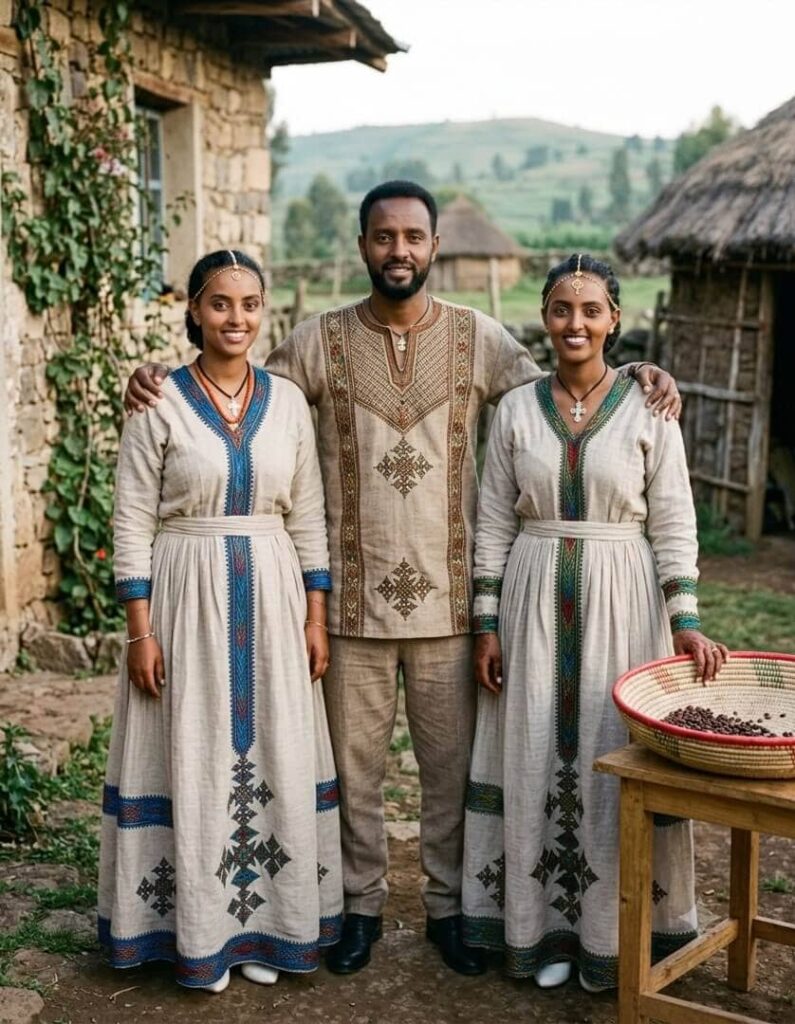
Weddings in Ethiopia also carry strong cultural identity, from the food served at gatherings to the attire worn by families on both sides. These elements reflect heritage and community pride, and they are often what people remember most. But none of these cultural expressions automatically determines whether a marriage is legally valid.
What this really means is simple: marriage in Ethiopia is not just about how the day looks or how it is celebrated. It becomes legally valid only when it meets specific requirements set by the law. This guide breaks down those requirements clearly, from age rules and eligibility to documents and the legal process that makes a marriage officially recognised.
What Makes a Marriage Legal in Ethiopia?
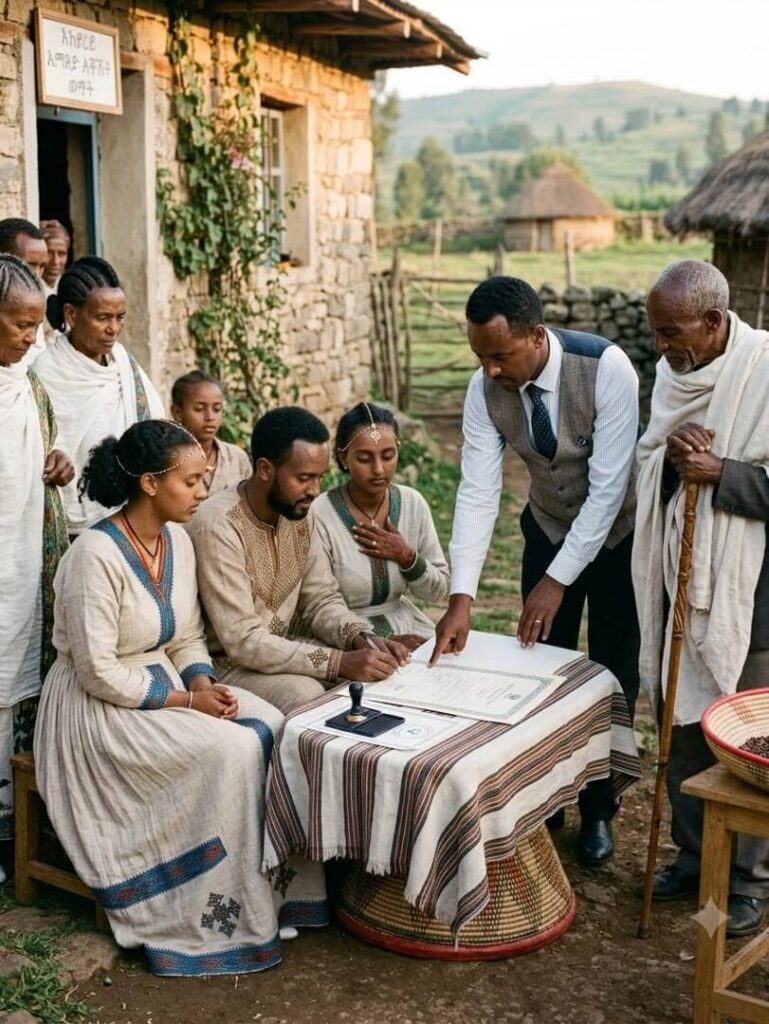
A marriage in Ethiopia only becomes legally valid when it meets specific conditions set under the Revised Family Code. This is the part many couples don’t fully think about at the beginning. The ceremony, the celebration, the family gatherings—all of that can happen, but the law still asks a simple question: did this union follow the required legal steps?
At the center of it all is the legal framework itself. Ethiopian marriage law recognizes civil, religious, and customary unions, but recognition alone is not enough. A marriage only gains legal force when it is properly recorded with the relevant civil authority. Without that step, the law treats the union as incomplete, even if everyone around the couple considers them married.
Consent comes next, and it is not just a formality. Both individuals must agree freely, without pressure from family, tradition, or circumstance. For example, if a couple is brought together through family arrangement but one person agrees out of fear or obligation, that marriage does not meet the legal standard. The law focuses on personal choice, not just agreement on paper or in ceremony.
Then there is the question of capacity to marry. This simply means both individuals must be legally able to enter into a marriage. They cannot already be married to someone else, and they must not fall within restricted family relationships defined by law. In practical terms, if someone is still legally married, even if separated in reality, any new union cannot be recognized until that status is legally resolved.
Age is one of the clearest rules. Both partners must be at least 18 years old. This is not flexible under normal conditions. So, even if a community accepts an earlier union culturally, the law does not treat it as valid unless the age requirement is met. This is one of the most common gaps between social practice and legal recognition.
Finally, there is registration, which is what ultimately gives the marriage legal standing. A couple may go through traditional or religious ceremonies, sometimes even with full family recognition, but if the marriage is not registered with civil authorities, it does not exist in the eyes of the law. It is similar to having an agreement that everyone acknowledges informally but has never been officially recorded.
This is why informal unions often create problems later on. A couple may live together for years, have children, and be recognized socially as husband and wife, but when legal issues arise, such as inheritance, property disputes, or documentation, the absence of registration becomes a serious barrier. In the eyes of the law, what was not registered was never fully completed.
So when we talk about what makes a marriage legal in Ethiopia, it is not one single factor. It is a combination of consent, age, legal capacity, and proper registration working together. Remove one of these, and the marriage may still exist socially, but it loses its legal standing.
Legal Age for Marriage in Ethiopia
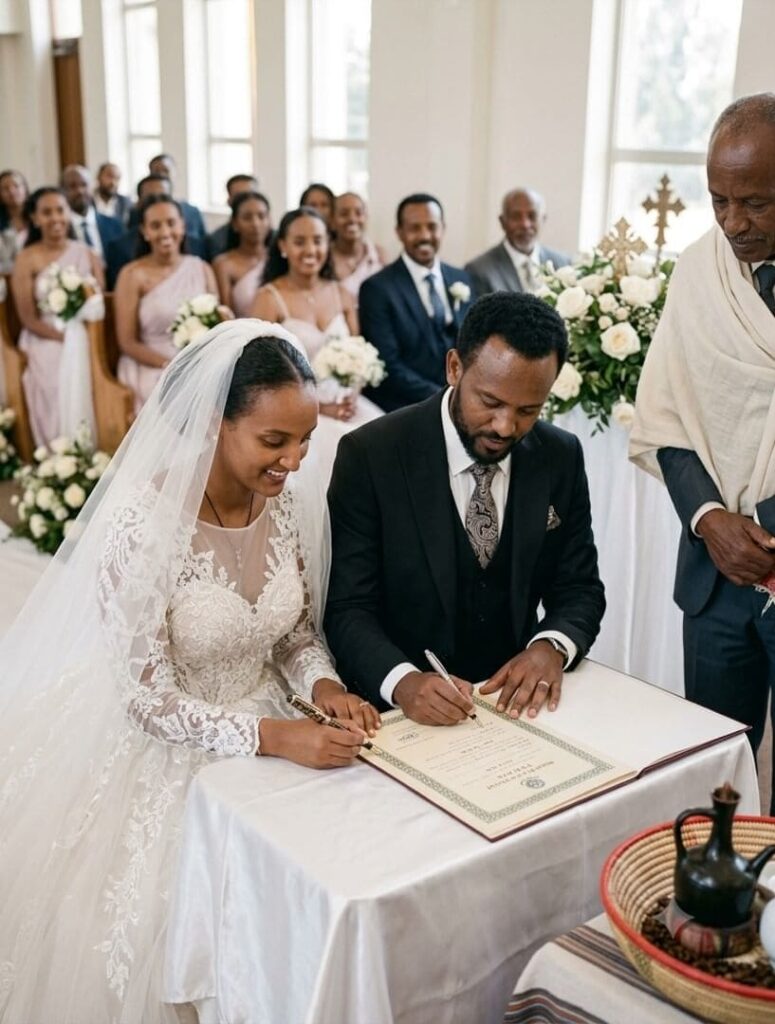
Age is one of the clearest lines the law draws when it comes to marriage in Ethiopia. It is not flexible, not symbolic, and not something that can be adjusted based on family agreement or cultural readiness. Under the Revised Family Code, both individuals must be at least 18 years old for a marriage to be legally valid.
In simple terms, this means the law only recognizes a marriage when both people have reached adulthood as defined by the state. So even if a couple is seen as ready by their families, or if traditional ceremonies are already completed, the marriage still does not meet legal standards if one or both parties are under 18.
There are very limited situations where exceptions are discussed in legal interpretation, but they are not treated as normal practice and usually require strict oversight from authorities. In reality, the legal system is designed to protect the minimum age rule as a firm boundary rather than a negotiable condition. So when people talk about “early readiness” or “family approval,” those ideas do not override the legal requirement.
To understand how this plays out, imagine a scenario where two families agree that a 17-year-old girl and an 18-year-old boy should marry. A traditional ceremony may take place, guests may celebrate, and the couple may even begin living together. But when it comes to legal recognition, the union is not valid. The missing element is not ceremony or acceptance, but legal eligibility based on age.
This is where the gap between social practice and legal recognition becomes clear. In many communities, age is viewed through readiness, maturity, or family circumstances. But the law uses a fixed standard to remove ambiguity. It does not measure emotional readiness or cultural expectations; it uses a defined number to determine legal capacity.
The reason age carries so much weight is that it connects directly to legal protection. Marriage is not just a social arrangement under Ethiopian law; it is a contract with rights and responsibilities attached to property, inheritance, and family status. Setting a minimum age ensures that both parties enter that contract with full legal capacity to understand and exercise those rights.
So while age may be seen differently in cultural conversations, in legal terms it is non-negotiable. Without meeting the age requirement, the marriage does not move forward in the eyes of the law, no matter how complete it may appear in practice.
Marriage Requirements in Ethiopia
Once age is settled, the law moves to the actual conditions that make a marriage valid. This is where many people assume things are automatic, but Ethiopian law is very specific about what must be in place before a union is accepted. These requirements are not just formalities; they are the legal safeguards that determine whether a marriage is real in the eyes of the state or not.
At the heart of it is a set of core rules that every couple must meet, no matter how the marriage is celebrated.
• Consent (no coercion)
A marriage only stands if both people agree to it freely. There must be no pressure, no threats, and no indirect forcing through family expectations or social pressure. For example, if a couple agrees to marry only because one family insists strongly or because one partner feels they have no choice, that consent is not considered valid in law. The agreement must come from personal will, not circumstance.
• Mental and legal capacity
Both individuals must be in a position to understand what they are entering into. This means they must be mentally able to make decisions and not be under legal restrictions that prevent marriage. For instance, someone who has been declared legally incapable or is not in a sound state of mind at the time of marriage cannot enter a valid union. The law looks at whether both people can fully understand rights, responsibilities, and consequences.
• Monogamy rules
Ethiopian civil law is built on the principle of monogamy. This means a person cannot be legally married to more than one spouse at the same time. So if someone is already in a registered marriage, any new attempt to marry another person is not legally valid. Even if a second ceremony happens, the law does not recognize it until the first marriage is legally ended through divorce or death.
• Prohibited relationships
The law also draws clear boundaries around family relationships. People who are closely related by blood, marriage, or adoption within restricted degrees cannot marry. This rule exists to prevent unions that fall within prohibited kinship lines. For example, even if two people agree and families accept it culturally, a marriage between close relatives within those legal boundaries will not be recognized.
• Witness requirements
Marriage is not treated as a private agreement between two people alone. It must be supported by witnesses who confirm that the union is real and willingly entered into. These witnesses play a legal role during registration, helping verify the identity and consent of the couple. Without them, the process is considered incomplete in most formal registration systems.
Taken together, these requirements show something important: Ethiopian law is not only concerned with whether two people decide to marry, but whether that decision meets strict standards of fairness, clarity, and legality. A ceremony without these elements may hold social meaning, but it does not automatically translate into legal recognition.
Types of Legal Marriage in Ethiopia
After understanding the core requirements that make a marriage valid, the next question naturally becomes how the law actually recognizes different kinds of marriages. In Ethiopia, marriage is not limited to one format. People come together through different systems, but the law only accepts them when they meet the same legal standard: proper recognition through the civil authority.
In practice, three main forms of marriage can be legally recognized, as long as they are registered and comply with the requirements we’ve already covered.
• Civil marriage
This is the most direct form of legal marriage. It happens through official state structures, usually at the local civil registry office. The process is straightforward: the couple submits documents, meets the legal requirements, and the marriage is recorded officially.
For example, a couple living in Addis Ababa may choose not to hold a traditional ceremony first. Instead, they go directly to the civil registry, complete the paperwork, and become legally married once it is registered. In this case, the law immediately recognizes the union because the process is built entirely around legal compliance.
• Religious marriage (recognized under conditions)
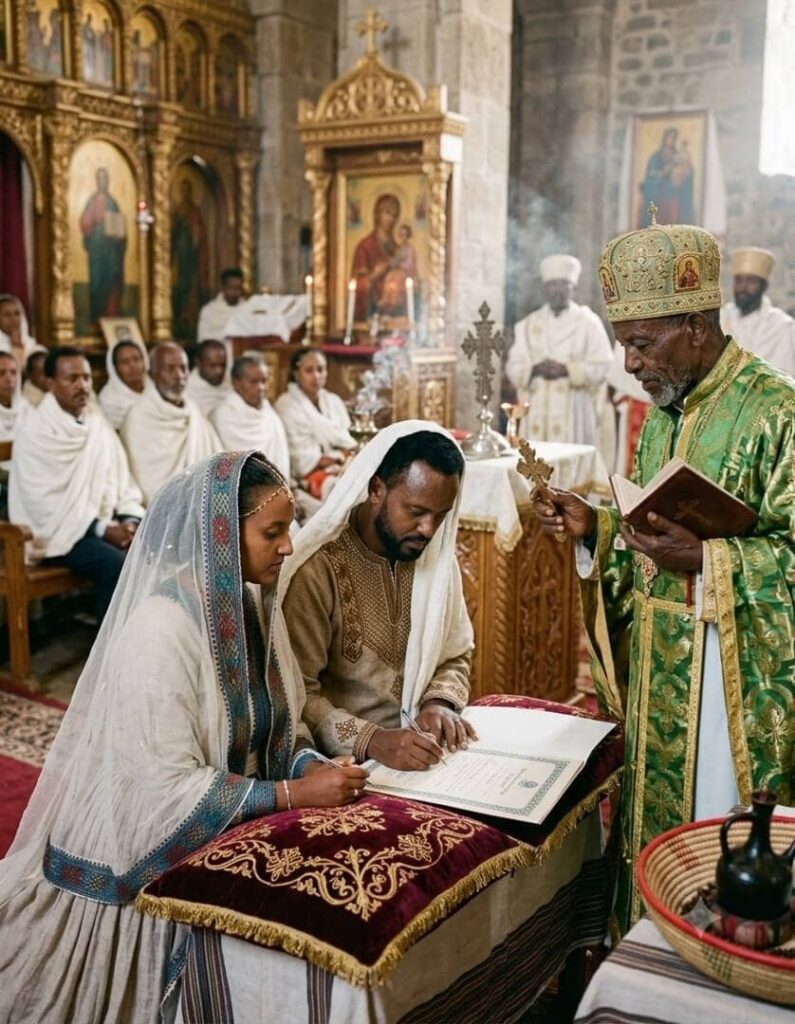
Religious marriages are widely practiced across Ethiopia, often carrying deep meaning for families and communities. However, from a legal point of view, the ceremony alone is not enough. It only becomes legally valid when it is registered with the relevant civil authority.
So imagine a couple who gets married in a church, mosque, or other religious setting. The ceremony may be fully accepted socially, but unless that marriage is later registered, it does not carry legal effect. Once registered, however, the law recognizes it in the same way as a civil marriage, provided all legal conditions are met.
• Customary or traditional marriage
Traditional marriages are deeply rooted in community practices and often involve family negotiations, elders, and cultural rituals. These marriages are widely respected socially, but legally, they only gain recognition after registration.
For instance, a couple may go through customary arrangements involving family elders and ceremonies within their community. Even if everyone acknowledges them as husband and wife, the law still requires formal registration for the marriage to have legal standing. Without that step, it remains socially valid but legally incomplete.
What this really shows is that Ethiopia does not reject different ways of getting married. Instead, it places one consistent condition over all of them: legal registration. Whether the marriage starts in a civil office, a religious setting, or a traditional ceremony, it only becomes fully valid when it enters the official legal system.
Documents Required for Marriage in Ethiopia
Even when a couple meets all the legal requirements and chooses a valid form of marriage, the process does not move forward without proper documentation. This is where many delays happen in real life. The law needs clear proof of identity, eligibility, and legal status before it can register a marriage officially.
These documents are not just paperwork. They are the evidence that the state uses to confirm that both individuals are legally free and qualified to marry.
• ID or national identification
Every marriage process starts with identity. Both individuals must present valid identification such as a national ID or passport. This confirms who they are and ensures there is no confusion or duplication in records.
For example, if a couple arrives at a registration office without valid identification, the process cannot proceed, even if everything else is in order. The law cannot register a marriage for people it cannot officially identify.
• Birth certificate (if applicable)
A birth certificate helps verify age and personal details. While not always requested in every case, it becomes important when there is a need to confirm eligibility, especially around age requirements.
In situations where age is questioned or documents are incomplete, this becomes a key supporting record that helps authorities confirm that both parties meet the legal threshold for marriage.
• Proof of eligibility (single, divorced, or widowed status)
One of the most important checks is whether each person is legally free to marry. This means confirming that neither party is currently married.
For instance, if someone was previously married, they must present a divorce certificate or proof of their spouse’s death. Without this, the law assumes the previous marriage is still valid, and a new one cannot be registered. This step prevents overlapping marriages and ensures legal clarity.
• Witness documents (if required)
Marriage in Ethiopia often involves witnesses who confirm the identity and consent of both parties. In some cases, their identification documents are also required during registration.
Think of witnesses as the legal observers of the process. They are not just symbolic participants; they help confirm that the marriage is real, voluntary, and properly conducted. Without them, registration can be incomplete or rejected depending on the local procedure.
• Court clearance or additional legal approval (if needed)
In certain situations, additional legal clearance may be required before a marriage can be registered. This usually applies when there are complications such as prior disputes, unclear marital status, or special legal circumstances.
For example, if there is uncertainty about whether a previous marriage was properly dissolved, authorities may request a court confirmation before approving a new registration. This step ensures that no legal conflict exists before the new union is recorded.
Taken together, these documents form the legal backbone of marriage registration in Ethiopia. They ensure that marriage is not just based on agreement between two people but supported by verifiable legal proof. Without them, even a fully celebrated union cannot move into official recognition.
Marriage Registration Process in Ethiopia
By the time a couple reaches this stage, everything may already feel settled. The ceremony might be planned, the families informed, and the documents prepared. But in Ethiopia, the marriage is not legally complete until it goes through official registration. This is the point where the union moves from personal agreement or cultural recognition into something the state formally records.
Understanding how this process works helps avoid delays and ensures the marriage is fully recognized from the start.
• Where registration happens
Marriage registration is handled by civil status authorities, typically at local municipal offices or kebele-level registration centers under the national system. This is the official entry point where the marriage is recorded in government records.
For example, a couple who completes a religious ceremony in their community must still go to their local registration office afterward. Without that step, their marriage remains socially recognized but not legally recorded.
• Step-by-step process
The process usually begins with the submission of documents, including identification, proof of eligibility, and supporting records. Once the documents are reviewed, officials verify that both individuals meet the legal requirements.
After verification, witnesses may be called in or recorded, and in some cases, a notice period is issued to allow objections if there are legal concerns. If everything is in order, the marriage is officially registered, and the couple is entered into the civil register.
At the final stage, the registrar approves the union and issues an official marriage certificate, which becomes the legal proof of marriage.
• Timeline expectations
The timeline can vary depending on the completeness of documents and the specific office handling the registration. In straightforward cases, where all documents are correct and there are no objections, the process can move relatively quickly.
However, delays often happen when documents are missing, unclear, or require additional verification. For example, if a divorce certificate or foreign document needs authentication, the process may take longer before registration is completed.
• Common mistakes people make
One of the most common mistakes is assuming the ceremony itself completes the marriage legally. Many couples delay registration, thinking it is optional, only to discover later that their marriage is not officially recognized.
Another frequent issue is incomplete documentation. Missing proof of marital status, unclear identification, or unverified foreign documents can pause the entire process. In some cases, couples also fail to involve proper witnesses during registration, which can lead to rejection or delays.
There are also situations where couples assume registration can be done much later without consequences. In reality, postponing registration can create complications, especially when legal proof of marriage is needed for property, inheritance, or administrative purposes.
In the end, the registration process is what turns a ceremony into a legally recognized marriage in Ethiopia. It is not just a final step; it is the point where the law officially acknowledges the relationship and gives it full legal standing.
Special Cases: Foreigners and Cross-Border Marriages
Marriage laws in Ethiopia are generally consistent for everyone, but things become slightly more complex when one or both partners are foreign nationals. These situations are treated carefully because they involve different legal systems, documentation standards, and verification processes. Still, one principle remains unchanged: the marriage only becomes legally valid through proper registration in Ethiopia.
• Requirements differ
When a foreign national is involved, the process usually requires additional checks compared to local marriages. This is mainly to confirm legal status in the person’s home country and ensure there are no legal barriers to marriage abroad.
For example, a foreign partner may be asked to provide official proof that they are legally free to marry in their country of origin. This helps Ethiopian authorities confirm that the marriage will not conflict with existing legal obligations elsewhere. The core requirements like age, consent, and eligibility still apply, but the supporting documents often go further than standard local cases.
• Registration is still required
Even when a marriage involves different nationalities or takes place across borders, registration in Ethiopia remains essential if the marriage is to be recognized under Ethiopian law. A ceremony alone, whether conducted abroad or within Ethiopia, does not automatically create legal status.
For instance, a couple may get married outside Ethiopia and later move into the country. In that case, the marriage still needs to be properly recorded with the relevant Ethiopian civil authority before it is fully recognized in legal systems such as inheritance, residency-related processes, or official documentation.
• Keeping the legal process central
What matters most in cross-border or mixed-nationality marriages is that Ethiopian law still acts as the final point of recognition. The process may involve extra steps, translations, or verification of foreign documents, but the foundation does not change. The marriage must still be formally entered into the civil registry system to be considered valid.
This is why couples in these situations are often advised to approach the process early and carefully. Small differences in documentation or legal interpretation can delay recognition, even when the marriage itself is already valid in another country.
In short, cross-border marriages are not treated differently in principle, but they do require more careful legal handling. No matter where the ceremony takes place or who is involved, Ethiopian recognition always depends on one final step: official registration.
Situations That Can Affect Marriage Legality
Even when a couple believes everything is in order, there are certain situations that can quietly affect whether a marriage is legally valid in Ethiopia. These are often the points where problems only show up later, especially when the couple tries to use the marriage certificate for official matters like property, inheritance, or administrative processes. Understanding these risks helps prevent a union from being socially accepted but legally questioned.
Here are the main situations that can affect legality.
• Missing registration
This is the most common issue. A marriage may be fully celebrated, witnessed, and accepted by both families, but if it is never registered with the civil authority, it does not exist legally.
For example, a couple may have gone through a full traditional ceremony and even lived together for years. But when they later try to obtain a marriage certificate, they discover there is no official record of their union. In legal terms, the marriage was never completed.
• Invalid consent
Consent is not just about saying “yes.” It must be free, informed, and without pressure. If it is later shown that one party agreed under coercion, fear, or serious family pressure, the validity of the marriage can be questioned.
Imagine a situation where one partner agrees to marry only because of repeated pressure from elders or fear of consequences at home. Even if the ceremony takes place, the law does not treat that agreement as fully valid if true free will was missing.
• Underage marriage
Age is a strict legal boundary. If either party is below the legal minimum age at the time of marriage, the union cannot be recognized under Ethiopian law.
In practice, this becomes a problem when communities rely on traditional expectations rather than legal standards. A marriage may be accepted socially, but if it involves someone under the legal age, it does not meet the requirements for recognition and may later be invalidated.
• Fraud or false documents
A marriage can also be affected if any of the supporting documents are fake, altered, or misleading. This includes identity documents, proof of marital status, or certificates used during registration.
For example, if someone presents a false document claiming they are single when they are still legally married, the entire registration process is compromised. Once discovered, the marriage can lose legal standing because it was built on incorrect information.
• Unrecognized unions
Some relationships exist in practice without ever going through the legal system. These are often long-term partnerships where couples live together and are seen socially as married, but they never complete registration.
The challenge with these unions is not their social reality, but their legal absence. When disputes arise—such as inheritance, separation, or official documentation—the law does not treat them as valid marriages because they were never formally recorded.
What all these situations show is something simple but important: in Ethiopia, marriage legality is not just about the ceremony or the relationship itself. It depends on whether the legal conditions were met clearly, honestly, and officially recorded. When any of those steps are missing or compromised, the marriage may lose its legal standing even if it is widely accepted in everyday life.
Final Thoughts
Marriage in Ethiopia is much more than a ceremony or a moment shared with family and friends. It becomes legally meaningful when the right requirements are met, from age and consent to eligibility, documentation, and registration. Each step plays a role in turning a personal commitment into a legally recognized union.
A beautiful celebration, a religious ceremony, or strong family support does not automatically make a marriage legally valid. The law focuses on whether the proper process was followed. That is why understanding the legal side before saying “I do” can prevent future challenges involving documentation, inheritance, property rights, and official recognition.
Before moving forward with marriage plans, take time to confirm the current requirements through the appropriate authorities. And if you are also exploring the cultural side of marriage in Ethiopia, you may want to learn more about Orthodox church weddings in Ethiopia, traditions and customs surrounding marriage ceremonies, and how dowry and bride price in Ethiopia continue to shape many wedding journeys today.