
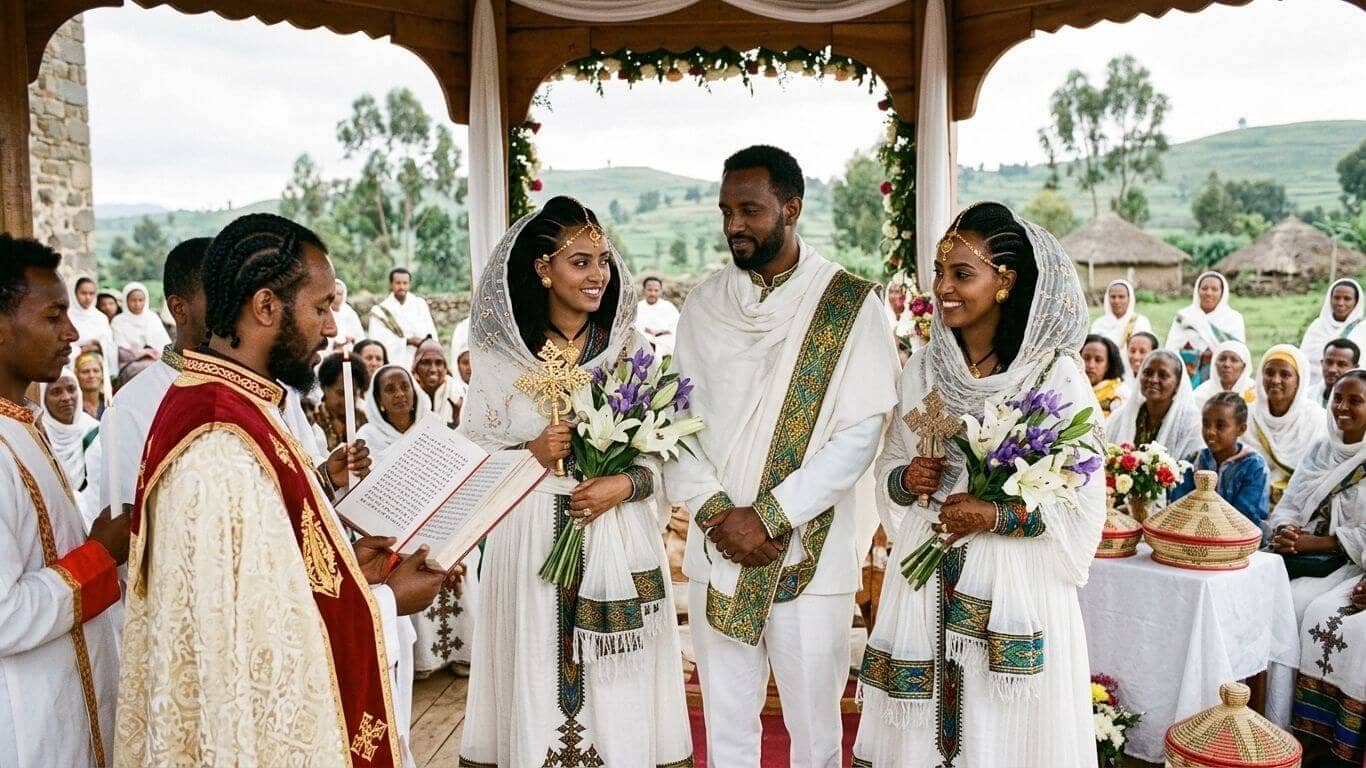
Polygamy in Ethiopia exists within a complex mix of culture, religion, and marriage laws that shape whether a man can have more than one wife.
Ethiopian marriages have long reflected more than the union of two people. Across the country, weddings often bring together families, elders, communities, and traditions that have been passed down for generations. If you look at marriage in Ethiopia, you quickly realize that it is shaped not only by personal choice but also by culture, religion, and social values that differ from one community to another.
Part of this diversity can be seen in the different types of marriages practiced across the country. Civil marriages, religious marriages, and customary marriages all exist within Ethiopia, and each follows its own traditions and customs. Some ceremonies may involve family negotiations, elder participation, symbolic exchanges, or practices that have remained important across generations.
Within some traditional communities, marriage customs historically extended beyond a union between one man and one woman. Certain customary practices placed importance on family expansion, lineage, social standing, and community relationships, creating space for arrangements where a man could have more than one wife. These traditions varied from place to place and were often shaped by local beliefs rather than a single national practice.
That is where the conversation around polygamy begins. In simple terms, polygamy refers to the practice of having more than one spouse at the same time. While the term is often used broadly, many people use it specifically when discussing a man marrying multiple wives because that is the form most commonly recognized in different parts of the world, including parts of Africa.
There is also an important distinction to understand. The most common form is polygyny, where one man is married to multiple wives. Another form, known as polyandry, involves one woman having multiple husbands, though this is far less common globally and is not traditionally associated with Ethiopian marriage practices. Understanding these differences makes it easier to explore how polygamy has existed within Ethiopia and how culture, religion, and law continue to shape it today.
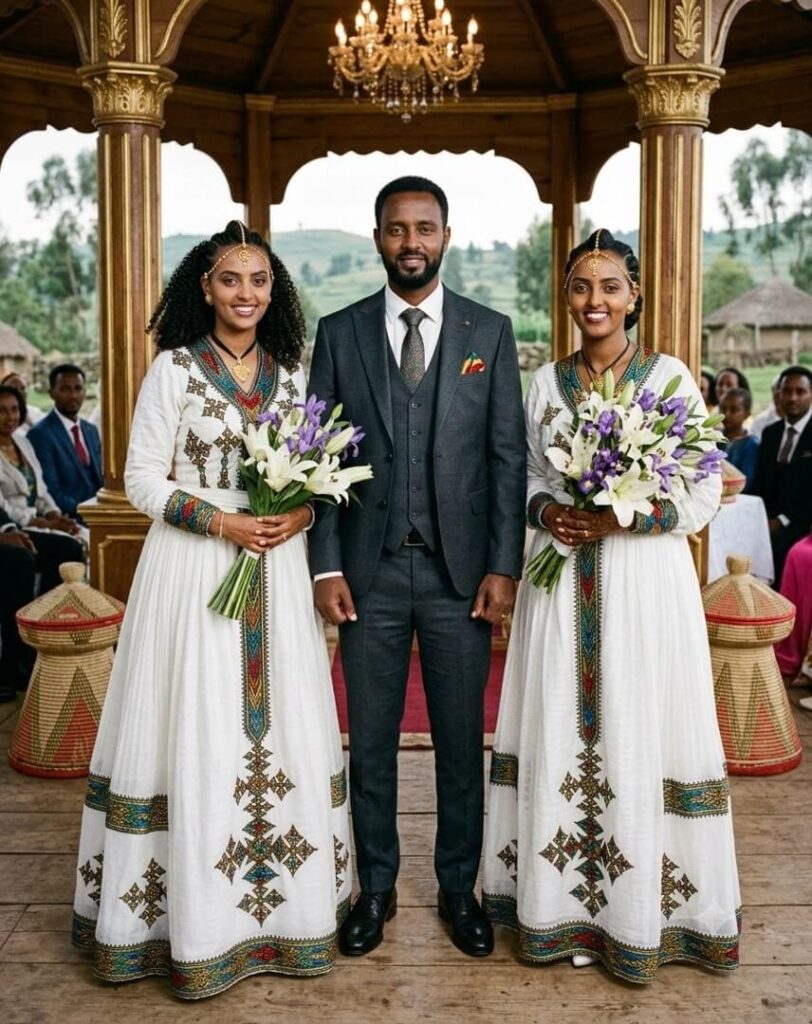
Can a Man Marry More Than One Wife in Ethiopia?
Short answer: legally, no. A man in Ethiopia is not allowed to marry more than one wife at the same time.
But that’s only part of the story.
Under federal law, marriage is meant to be monogamous. If someone is already married and goes ahead to marry another person, that second marriage is considered invalid and can even attract criminal punishment under the country’s legal code. On paper, the rule is clear and strict.
Here’s the thing, though: real life doesn’t always follow the paper.
In practice, polygamy still exists in several communities across Ethiopia, especially in areas where religious and customary systems carry a lot of weight. In some Muslim and pastoralist communities, a man may have more than one wife under religious or traditional acceptance, even if the state does not formally recognize it. So you end up with this legal tension: the government says one thing, while local practice in some regions operates differently.
What this really means is that whether a man can marry more than one wife in Ethiopia depends on which system you’re looking at. Legally, it’s not allowed. Socially and culturally in some places, it still happens and is quietly accepted.
So the answer is simple, but the reality is layered.
What Ethiopian Law Says about Polygamy
Ethiopian law is actually pretty direct on paper, but layered in practice. If you look only at the formal civil system, polygamy is not allowed. But once you factor in how family law, criminal law, and customary systems overlap, things get more complicated.
Civil marriage laws
Under Ethiopia’s civil marriage framework, marriage is built on monogamy. The Revised Family Code (Proclamation No. 213/2000) treats marriage as a union between two people only. That means once a person is legally married, they’re not supposed to enter another marriage unless the first one is properly dissolved.
So in civil terms, Ethiopia doesn’t recognize multiple simultaneous spouses. Only one marriage is valid at a time, and everything else falls outside legal protection.
Legal restrictions
The restriction becomes even clearer in criminal law. The Ethiopian Criminal Code criminalizes bigamy, meaning you cannot legally contract another marriage while still bound by an existing one. In simple terms, the law is trying to protect the integrity of marriage and prevent overlapping unions.
But here’s where it gets interesting. There’s also a legal carve-out tied to religious and customary practice. In some interpretations, marriages conducted under recognized religious or traditional systems may not be treated the same way as civil bigamy cases. That’s part of what creates the grey area in enforcement.
So yes, polygamy is restricted, but the enforcement isn’t always straightforward.
Recognition and limitations
This is where Ethiopia’s legal system shows its complexity.
At the federal level, polygamous marriages are not formally recognized. That means issues like inheritance, property rights, and legal identity become difficult for spouses in such unions, especially women who are not in the first legally registered marriage.
At the same time, in regions where religious and customary laws play a strong role, polygamous unions can still be socially valid and functionally accepted. Courts and local systems may acknowledge them in practice, even if federal law doesn’t fully endorse them.
What this really creates is a gap between legality and reality. The law sets one standard, but everyday life in some communities operates on a different one.
So Ethiopian law doesn’t exactly say polygamy is “okay” or “not okay” in a simple way. It bans it in civil terms, restricts it in criminal terms, but still leaves room for cultural and religious systems that keep it alive in practice.
Religious and Cultural Views on Polygamy in Ethiopia
This is where Ethiopia really shows its complexity. The law may lean one way, but religion and culture have their own long-standing rules, and they still shape how marriage works in everyday life.
Islamic communities
In many Muslim communities in Ethiopia, polygyny (a man having more than one wife) is religiously permitted under Islamic law. It’s usually framed around responsibility rather than lifestyle. The expectation is simple in principle: if a man takes more than one wife, he must be able to treat them fairly and provide for them equally.
In places like Somali and Afar regions, where Islamic tradition is deeply rooted in daily life, this practice is more socially visible and more openly accepted. It’s not seen as unusual in the same way it might be elsewhere, even though state law doesn’t formally recognize it as a civil norm.
Ethiopian Orthodox traditions
Within the Ethiopian Orthodox Tewahedo Church, marriage is traditionally monogamous. The religious teaching centers on one husband and one wife as the standard for Christian marriage.
So in Orthodox communities, polygamy isn’t supported religiously. If it happens, it usually sits outside the religious structure rather than inside it. That creates a clear contrast with Islamic practice in the country, especially when you look at marriage norms across different regions.
Customary practices among some communities
Beyond formal religion, customary systems also play a big role. In several rural and pastoralist communities, polygamy has historically been tied to social structure, labor needs, wealth distribution, and family size.
This is where the practice becomes less about doctrine and more about lived reality. In some areas, especially remote regions, having multiple wives has traditionally been linked to status, survival, or household capacity. That’s part of why the practice persists even though national law discourages it.
What this all adds up to is a simple tension: religion and custom don’t always move in the same direction as civil law. And in Ethiopia, that gap is exactly where polygamy continues to exist.
Communities and Traditions Where Polygamy Has Historically Existed
Polygamy in Ethiopia isn’t spread evenly. It shows up more in certain regions, shaped by history, religion, and how communities have traditionally organized family life.
Regional and ethnic variations
The clearest pattern is geography. In pastoralist and rural regions, polygamous unions are more common compared to urban centers where monogamy dominates both legally and socially.
Regions like Somali and Afar stand out. These areas have some of the highest reported rates, and the practice is closely tied to Islamic tradition and pastoralist livelihoods. In other regions like Gambella, Benishangul-Gumuz, and parts of the southern areas, the practice also exists, influenced more by customary systems than formal religious rules.
In contrast, places like Tigray and major urban centers show much lower prevalence. Here, civil law norms and urban lifestyles tend to shape marriage patterns more strongly than tradition.
Traditional marriage practices
Historically, polygamy in some Ethiopian communities wasn’t just about marriage choice in a modern sense. It was tied to how families built strength and survival.
In pastoralist settings, for example, larger households meant more labor, more herding capacity, and more stability in unpredictable environments. In agrarian or rural societies, it could also be linked to land use, social status, and the ability to support extended families.
There’s also the cultural element of lineage and continuity. In some traditions, having more children and multiple households was seen as a way of strengthening family ties and securing long-term support systems.
What stands out is that these practices didn’t develop in isolation. They were shaped by environment and necessity as much as belief. And even today, those historical patterns still influence how some communities view marriage, even as national law moves in a different direction.
Why Some Families Practice Polygamy
Polygamy in Ethiopia doesn’t come from a single reason. It’s usually a mix of culture, economics, and social pressure working together. And once you understand that, it becomes easier to see why the practice hasn’t disappeared even with legal restrictions.
Cultural reasons
In some communities, polygamy is deeply tied to tradition and identity. It’s not just about marriage but about how families are expected to grow and structure themselves. In certain religious and customary settings, especially where Islamic law or long-standing local traditions are influential, having more than one wife is seen as socially acceptable and, in some cases, part of a respected way of life.
There’s also the idea of continuity. Larger families are often associated with strength, stability, and legacy. That mindset doesn’t vanish quickly, even when modern legal systems shift in a different direction.
Economic and social reasons
Economics plays a bigger role than people often admit. In rural and pastoralist areas, more family members can mean more hands to work, herd animals, or manage household responsibilities. Historically, that made larger families more practical than symbolic.
There’s also a social safety angle. In communities where resources are shared and survival depends on family networks, having multiple wives and larger households can sometimes be seen as a way of spreading responsibility and ensuring support systems stay strong.
But it’s not always balanced. As you already pointed out in your research, these arrangements can also strain household resources, especially when income is limited and family size grows quickly.
Family and community influences
This is where things become more personal.
In many cases, polygamy isn’t just a decision between two people. It’s influenced by parents, elders, and the wider community. Marriage decisions can carry strong expectations, and in some areas, social acceptance still plays a big role in whether a man takes another wife.
Once a practice is normalized in a community, it tends to reinforce itself. Younger generations grow up seeing it as part of life, not as something unusual or controversial.
So when you put it all together, polygamy in Ethiopia isn’t just about individual choice. It sits at the intersection of tradition, practicality, and community expectation, which is why it continues to exist even alongside formal legal restrictions.
How Common Is Polygamy in Ethiopia Today?
Polygamy in Ethiopia today sits in a kind of in-between space. It’s less visible than it used to be in some areas, but it hasn’t disappeared. What’s changed is how it shows up, where it’s common, and how people talk about it.
Changes over time
If you look back a few decades, polygamy was more openly tied to tradition in many rural communities. Today, that visibility has reduced in formal settings, especially in cities where civil marriage laws dominate.
But the data still tells a different story underneath. National surveys like the EDHS have consistently shown that a noticeable share of married women are still in polygynous unions, even if the practice is not officially recognized. So the trend isn’t a clean decline. It’s more like a slow shift from open tradition to quieter, less formal arrangements.
In short, it hasn’t vanished. It has just become less visible in official systems.
Urban vs rural differences
This gap is probably the clearest part of the picture.
In urban areas, monogamous marriage is the norm. Civil registration systems, education levels, and changing social expectations all push in that direction. Polygamy exists, but it’s far less common and often socially discouraged.
In rural and pastoralist regions, the reality is different. Places like Somali, Afar, and other remote areas still report higher levels of polygynous marriages. In these settings, tradition, religion, and community structures carry more weight than formal civil systems.
So geography matters a lot. Where you live in Ethiopia often shapes how marriage is understood and practiced.
Modern attitudes
Attitudes are shifting, but not evenly.
Among younger generations, especially in urban settings, there’s a growing preference for monogamous marriage. Education, economic pressure, and exposure to different lifestyles are all influencing that change.
At the same time, in communities where polygamy is tied to religion or long-standing cultural practice, it still carries social acceptance. Not always as a default choice, but as something that remains normal under certain conditions.
So what you get today is a mixed picture. Formal systems lean strongly toward monogamy, but social reality still holds pockets where polygamy remains part of everyday life.
Challenges and Conversations around Polygamy
Polygamy in Ethiopia isn’t just a legal or cultural topic. It plays out in real family lives, and that’s where the real tension shows up. Most of the ongoing conversation around it comes down to how it affects people day to day and whether the systems around it actually protect them.
Family dynamics
Inside families, polygamous arrangements can be complicated. Relationships between co-wives, children, and the husband often come with emotional and financial pressure. When resources are limited, household distribution becomes a constant source of strain.
Your research already points to this clearly: larger households can stretch income thin, affect access to education, and create imbalance in how responsibilities are shared. In many cases, the first wife often ends up carrying a heavier burden, both emotionally and practically, especially when legal protections are unclear or not enforced.
So while the structure may be socially accepted in some places, it doesn’t always translate into stability inside the home.
Legal and social discussions
On the legal side, Ethiopia is still dealing with contradictions. Federal law bans polygamy and treats bigamy as a criminal offense, but enforcement is inconsistent. At the same time, customary and religious systems continue to recognize or tolerate these unions in practice.
This creates an ongoing debate: how do you respect cultural and religious diversity while still protecting equal rights, especially for women and children?
International frameworks like CEDAW and the Maputo Protocol also push the conversation further, encouraging states to promote equality while acknowledging the reality that these unions still exist. So the discussion isn’t just local anymore. It’s tied to broader human rights expectations as well.
Changing views among younger generations
Among younger Ethiopians, especially in urban areas, attitudes are clearly shifting. Monogamy is becoming the expected norm, shaped by education, urban life, and changing ideas about partnership and equality.
There’s also a practical side to it. Many younger people see smaller, more financially manageable families as more realistic in today’s economy. That alone is reshaping how marriage is viewed.
Still, change isn’t uniform. In communities where polygamy is tied to religion or long-standing tradition, it continues to be accepted, even if younger generations there may approach it more cautiously than before.
So what’s happening now is less of a clean break and more of a slow transition. Different generations, and different parts of the country, are moving at different speeds.
Final Thoughts
Polygamy in Ethiopia sits at the intersection of law, religion, and lived reality. On paper, the law is clear: marriage is meant to be monogamous, and bigamy is prohibited under federal legal frameworks. But in practice, things don’t fully align with that rule, especially in communities where religious and customary systems still shape how marriage is understood and lived.
Across different regions, the picture changes. In some areas, particularly rural and pastoralist communities, polygamy remains part of social tradition and religious practice. In others, especially urban settings, monogamy has become the dominant norm. This uneven reality is what keeps the debate alive, because one legal system is trying to regulate a society that doesn’t move in a single direction.
At the heart of it all are real human consequences, especially for women and children. Issues like property rights, household stability, and legal protection remain central to the conversation. And as Ethiopia continues to evolve, the big question isn’t just about whether polygamy exists or not but how the law, culture, and society can coexist without leaving people unprotected in the process.