Polygamy in Uganda means a man can marry multiple wives under certain laws—but how legal it is, how many wives are allowed, and how it works in real life depends on the type of marriage.
Marriage in Uganda isn’t one-size-fits-all. From traditional ceremonies to religious unions and civil registrations, the way people marry shapes what’s allowed inside the marriage itself. If you’ve explored weddings in Uganda, Ugandan wedding traditions, or the different types of marriages in Uganda, you’ve probably noticed one thing—some systems recognize more than one spouse, while others don’t.
That question came into sharper focus in July 2025 when Uganda’s Constitutional Court made it clear: a man can legally marry multiple wives. The case was brought by the Women’s Pro Bono Initiative (WPI), which argued that polygamy is harmful and discriminatory. But the court didn’t find enough evidence to ban it, instead affirming it as part of cultural and religious expression.
The ruling didn’t settle the conversation—it expanded it. It sparked debate across the country, especially online, with some Ugandan women pushing back and asking a different question: if men can marry multiple wives, should women also be allowed to have multiple husbands? That’s where conversations around fairness, tradition, and modern relationships start to collide.
What this really means is that polygamy in Uganda isn’t just about whether it’s allowed—it’s about how it’s allowed, where it applies, and what kind of marriage you’re in. And that’s where most people get confused.

What Polygamy Means in Uganda (And Why It Exists)
At its core, polygamy in Uganda usually means polygyny—one man having multiple wives. It’s not a two-way system. A woman cannot legally have multiple husbands, and socially, that idea is still widely rejected. So when people talk about polygamy in Uganda, they’re almost always referring to men marrying more than one wife within certain cultural or religious settings.
This isn’t a new or fringe practice. Polygamy is deeply rooted in traditional Ugandan society and is also part of Islamic family life. Long before modern legal systems, marriage wasn’t just about two individuals—it was about families, lineage, and social structure. In many communities, having multiple wives was tied to identity, respect, and continuity.
Historically, there were practical reasons behind it. Larger families meant more hands to work, especially in agrarian settings. It also strengthened alliances between families and sometimes signaled wealth or status. A man who could support multiple households was often seen as stable and successful. In some cases, it was also framed as a way to provide for more women within the community.
Today, the reasons are more mixed. In some areas, it remains a respected cultural norm. In others, it exists quietly—sometimes even within religious communities that officially promote monogamy. You’ll hear stories of second or third families only becoming publicly known much later. At the same time, attitudes are shifting, especially among younger and urban Ugandans, where economic pressure, changing relationship expectations, and debates about fairness are reshaping how people view polygamy.
Is Polygamy Legal in Uganda? (2025 Constitutional Court Ruling)
Yes, polygamy is legal in Uganda—and that position was firmly reinforced in July 2025 by the Constitutional Court. The ruling settled a long-standing question by confirming that men can legally marry more than one wife under specific legal systems recognized in the country.
The case was brought by the Women’s Pro Bono Initiative (WPI), which challenged the legality of polygamy. They argued that it promotes inequality, harms women emotionally and economically, and should be considered a violation of constitutional rights. But the court didn’t agree. It found no strong evidence that polygamy, on its own, breaches the Constitution’s guarantees on equality, dignity, or protection from inhuman treatment.
A key part of the decision was how the court viewed different types of marriage. Justice Margaret Tibulya explained that polygamous and monogamous marriages operate under separate legal frameworks, so they can’t be judged by exactly the same standards. In simple terms, the court said treating them differently doesn’t automatically mean discrimination.
The final takeaway is clear: polygamy remains legally recognized in Uganda because it is tied to cultural and religious freedom. As long as it happens within those accepted systems, it is not considered a violation of rights under the Constitution.
Types of Marriages That Allow Polygamy in Uganda
Ugandan law recognizes different forms of marriage, and each one comes with its own rules around whether a person can have more than one spouse.
The main types of marriage in Uganda include:
- Customary (traditional) marriage
- Civil (court) marriage
- Religious marriage, which covers:
- Christian (church) marriage
- Islamic (Muslim) marriage
- Hindu marriage
Not all of these allow multiple spouses.
Marriage types that allow polygamy:
- Customary marriage
- Islamic marriage
Marriage types that do not allow polygamy:
- Civil marriage
- Christian marriage
- Hindu marriage
Here’s how the key ones work:
1. Customary Marriage
- Rooted in traditional practices across different ethnic groups
- Recognizes polygyny (one man, multiple wives)
- No fixed legal limit on the number of wives
- Widely practiced in many communities
2. Islamic Marriage
- Governed by Islamic law
- Allows up to four wives
- Requires fairness in time, treatment, and financial support
- Common within Muslim communities
3. Civil Marriage
- Governed by statutory law through the state
- Strictly monogamous
- A man cannot legally take another wife under this system
- Doing so can lead to bigamy charges
What this means:
Yes, a man can marry multiple wives in Uganda, but only under customary or Islamic marriage. Once it’s a civil or church wedding, it becomes strictly one wife.
How Many Wives Can a Man Have in Uganda?
There is no single number that applies to every man in Uganda. The answer depends on the type of marriage and, in reality, what he can actually sustain.
Under customary marriage
- No fixed legal limit on the number of wives
- A man can marry multiple wives based on tradition and personal capacity
- In practice, this varies widely between communities
Under Islamic marriage
- A man can marry up to four wives
- This comes with strict conditions
- He must treat all wives fairly in terms of time, care, and financial support
Under civil marriage
- Only one wife is legally allowed
- Any additional marriage is not recognized and can amount to bigamy
Reality on the ground (what the law doesn’t fully capture)
- Financial ability is the biggest limiting factor
- More wives usually means more households, more children, and higher costs
- Social pressure and family dynamics also play a role in how far a man can go
Theory vs reality
- On paper, some systems allow multiple wives
- In real life, most families are limited by money, stability, and responsibility, not just the law
A man in Uganda can have more than one wife, but how many he actually has depends on the marriage system and what he can realistically sustain.
The Story of the Man with 12 Wives in Uganda
One of the most well-known examples of polygamy in Uganda is the story of Musa Hasahya Kasera, a Ugandan farmer whose family has drawn global attention because of its size, not controversy.
At 68 years old, he has 12 wives, 102 children, and 578 grandchildren. For years, his household kept expanding, shaped by tradition and the belief that having a large family was a sign of strength, legacy, and continuity.
But over time, reality caught up with that idea. Hasahya publicly said he has stopped having more children, pointing to the rising cost of living and the difficulty of providing for such a large number of dependents. He has even encouraged his wives to use family planning to avoid further pregnancies, effectively bringing an end to decades of family expansion.
What makes this story important isn’t the numbers alone. It shows the tension between cultural expectations and economic reality. In theory, polygamy can build large, extended families. In practice, sustaining them becomes a serious financial and social challenge, especially when resources are limited.
Mukono Man Who Married Seven Wives in One Ceremony
Polygamy in Uganda isn’t just theoretical or historical. In some cases, it is still openly practiced and publicly celebrated within customary marriage systems.
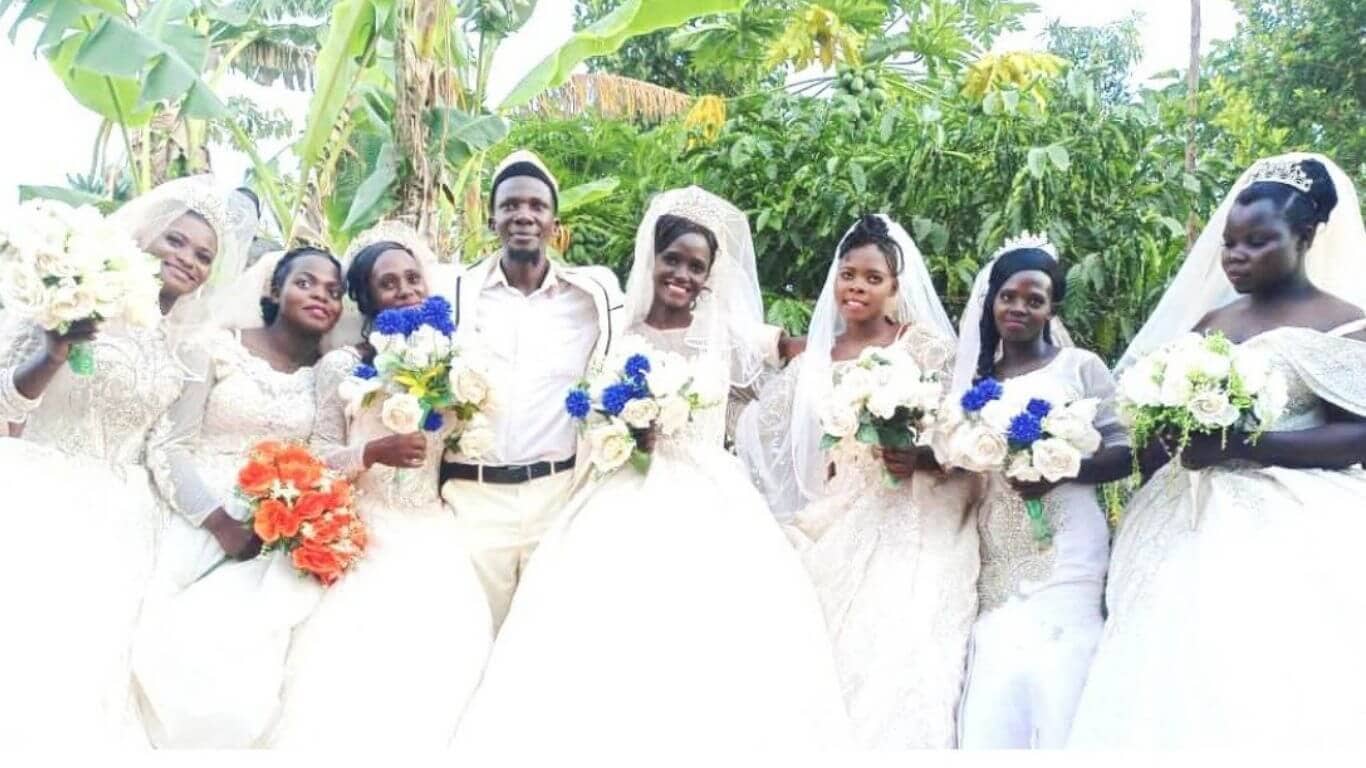
One widely reported example is that of Ssaalongo Nsikonenne Habib Ssezzigu, a businessman and traditional healer from Mukono District, who made headlines in 2023 after marrying seven wives in a single ceremony. The wedding reportedly included two biological sisters among the brides, and later reports even suggested he added an eighth wife.
The ceremony itself drew massive public attention. A convoy of vehicles and boda boda riders escorted the bridal procession through different towns, turning the event into a public spectacle. Each bride was presented as part of a shared union, and according to reports, the wives appeared cooperative within the arrangement.
What made the story go viral wasn’t just the number of wives, but how openly the marriage was conducted under customary practice. It highlighted a reality where polygamy is not hidden in some communities, but expressed as a cultural and social statement.
At the same time, it also reflects the broader debate in Uganda, where such marriages can be culturally accepted in certain settings, yet remain controversial when viewed through modern discussions on equality, relationships, and legal reform.
Cultural Reality: How Polygamy Affects Families and Relationships
Beyond the law and definitions, polygamy in Uganda is really lived out inside homes. It shapes how families function day to day, how resources are shared, and how relationships grow or struggle over time. The reality is often more complex than the tradition itself.
Here’s how it shows up in real life:
Household dynamics
- Multiple wives often manage separate households or shared compounds
- Roles and responsibilities are divided, sometimes unevenly
- Relationships between co-wives can range from cooperative to tense
- The husband’s time and attention become a central point of balance
Financial pressure
- More wives usually means more children and higher daily costs
- Education, healthcare, and basic needs become long-term financial strains
- Income is often stretched across multiple households
- Some families struggle to maintain stability as numbers grow
Emotional and social impact
- Feelings of competition or comparison can arise between wives
- Emotional support may be divided, not shared equally
- Children may experience differences in attention and treatment
- Social perception varies, with some communities accepting it and others questioning it
Children and inheritance
- Large families can make inheritance and property division complicated
- Disputes may arise if arrangements are not clear
- Children’s opportunities can vary depending on household stability
- Long-term planning becomes essential, but it is not always well structured
Polygamy in Uganda is not just a marital structure. It’s a full family system that affects economics, emotions, and long-term stability in very real ways.
Debate: Culture vs Women’s Rights
Polygamy in Uganda sits in the middle of a long-running debate. For some, it is a cultural and religious practice that deserves protection. For others, it raises serious questions about equality, dignity, and fairness in relationships.
Here’s how both sides look at it:
Supporters of polygamy (culture, religion, identity)
- Seen as part of Ugandan cultural heritage in many communities
- Recognized within Islamic and customary systems
- Viewed as a legitimate family structure, not an exception
- Some argue it reflects social reality and long-standing traditions
- Often defended as a matter of personal and religious freedom
Critics of polygamy (women’s rights, fairness, economic strain)
- Seen as reinforcing inequality between men and women
- Concerns about emotional neglect and unequal treatment within families
- Financial pressure increases as families grow larger
- Some argue it can affect women’s dignity and decision-making power
- Activists push for stronger protections and reforms in marriage law
The tension in simple terms
- One side sees it as identity and tradition
- The other sees it as a system that can disadvantage women in practice
What makes it complex
- Even critics acknowledge it is deeply rooted in society
- Even supporters recognize that outcomes depend heavily on how the household structure is managed
The debate isn’t just about whether polygamy should exist—it’s about how tradition and modern rights standards can exist in the same legal space without clashing completely.
Proposed Reforms and the Marriage Bill 2024
Even though polygamy is legally recognized in Uganda, the conversation around it is far from settled. Lawmakers and activists are now pushing for reforms that try to bring more structure, accountability, and protection into how these marriages work in practice.
Here’s what’s being discussed:
Consent from existing wives
- Proposed requirement that a man must get approval from his current wife or wives before taking another
- Aims to reduce surprise marriages and improve transparency within families
- Intended to strengthen women’s voice inside the marriage structure
Financial capacity checks
- Proposal that a man must prove he can support multiple households
- Focus on income stability before additional marriages are approved
- Meant to reduce cases where families struggle financially after expansion
Housing and living arrangements
- Discussions around requiring separate housing for each wife
- Designed to reduce household tension and improve independence
- Also linked to improving dignity and privacy within families
Public debate and emerging conversations
- The reforms have triggered wider national discussion online and in public forums
- Some voices have raised the idea of polyandry, arguing for legal equality between men and women in marriage rights
- Others see this as a challenge to cultural norms and traditional family structures
The bigger picture
- The Marriage Bill 2024 reflects a shift toward regulating, not banning, polygamy
- It shows an attempt to balance cultural practice with modern expectations of fairness and protection
The direction of reform is not about removing polygamy from Ugandan society, but about putting clearer rules around it so that rights, responsibilities, and financial realities are better managed.
Polygamy in Uganda vs Other Countries
Polygamy in Uganda makes more sense when you place it beside how other societies handle it. What is accepted in one legal or religious system can be completely banned in another.
Islamic law (structured allowance)
- Polygamy is permitted in many Muslim-majority countries
- A man may marry up to four wives
- Conditions usually apply, especially fairness and financial responsibility
- It is regulated, not unrestricted
Western countries (generally illegal)
- Polygamy is not legally recognized in most Western nations
- It is often treated as bigamy if multiple marriages are entered into
- Marriage laws are strictly monogamous under civil law
- Cultural practice does not override legal restrictions
Christianity vs traditional practices
- Modern Christian marriage typically supports monogamy
- Biblical references to polygamy exist, but most modern churches do not practice it
- Traditional African systems, including those in Uganda, historically accepted multiple wives
- This creates a divide between religious doctrine and cultural practice in some communities
What this comparison shows
- Polygamy is not viewed the same way globally
- Its acceptance depends heavily on legal systems, religion, and cultural history
- Uganda sits in a space where customary, religious, and statutory laws overlap
What is normal in one country can be illegal in another, and Uganda reflects that complexity more than most places because multiple legal and cultural systems exist side by side.

Final Answer: Can a Man Marry Multiple Wives in Uganda?
Yes, a man can marry multiple wives in Uganda, but only under specific marriage systems.
Under customary and Islamic marriage, polygamy is legally recognized. These systems allow a man to take more than one wife, with Islamic law setting a limit of up to four wives and customary law leaving the number largely dependent on tradition and personal capacity.
However, this is not allowed under civil or church marriage. Once a marriage is registered as a civil union, it becomes strictly monogamous, and taking another wife under that system is not legally recognized.
So while polygamy is legal in Uganda, it is not universal across all forms of marriage. It exists within defined cultural and religious frameworks, and how it is practiced continues to be debated, regulated, and re-examined as society evolves.