
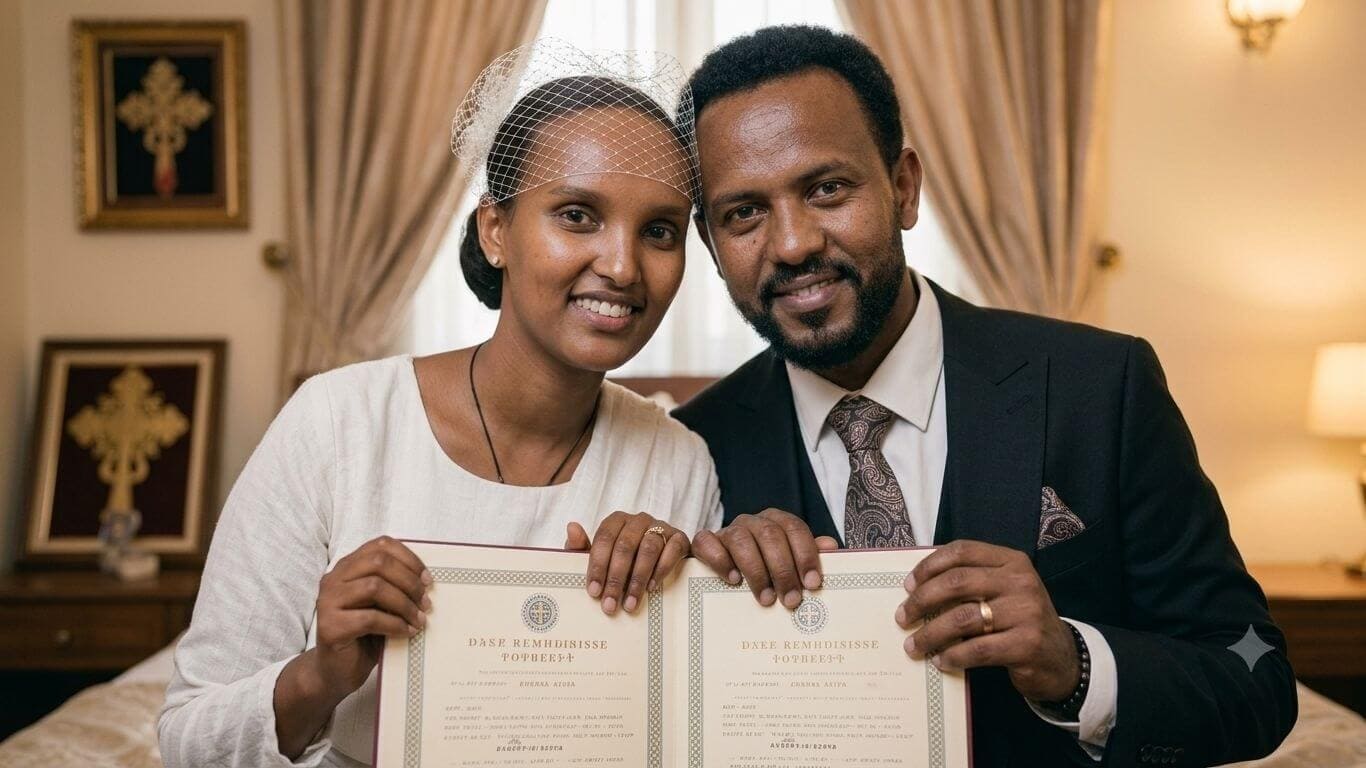
Civil marriage, sometimes referred to as a court marriage, is one of the legally recognized forms of marriage in Ethiopia under the Federal Family Code. Here’s everything you need to know.
Picture a couple planning their big day. The conversations are already moving fast: what to wear, the wedding theme, photography concepts, videography angles, and even the content creators who will capture every behind-the-scenes moment and turn it into something people will talk about online. The excitement is real, and understandably, most of the attention goes to making the day beautiful and memorable.
In Ethiopia, weddings are more than ceremonies. They are often shaped by culture, family, and identity. From the traditions across tribes, music, and food that define celebrations to deeply rooted practices that have been passed down for generations, every wedding carries a story. Some couples choose traditional paths, and others choose religious ceremonies like Ethiopian Orthodox weddings, while many simply want a straightforward legal process.
Different types of marriages in Ethiopia also come with different experiences and expectations. Many traditional unions involve customs and rites that families value deeply. Practices such as shimagelay, where elders from the groom’s family meet the bride’s family to ask for her hand in marriage and discuss dowry matters; telosh, where gifts and bride price are presented; and kelekel, an intimate gathering between families after the wedding, continue to play an important role in many communities.
Still, while these customs hold meaning, couples sometimes overlook something equally important: the legal process behind marriage itself. A beautiful ceremony and family approval do not automatically complete the legal side of marriage. This is one reason many couples choose civil marriage. It provides a clear and structured route that gives the union official legal recognition.
If you are considering a civil marriage in Ethiopia, understanding the process early makes things much easier. This guide walks through everything you need to know, from requirements and documents to the registration process and marriage certificate details.
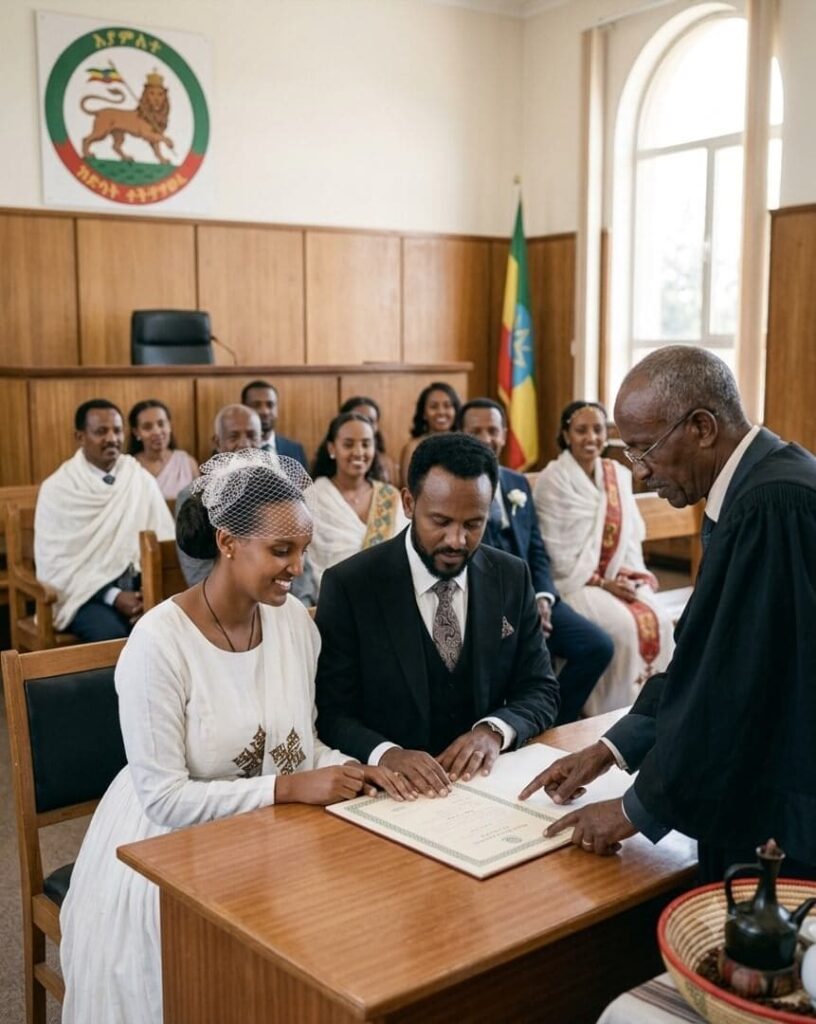
What Is a Civil Marriage in Ethiopia?
A civil marriage in Ethiopia is the official legal form of marriage conducted before a civil status registrar under the Federal Family Code. In simple terms, it is the moment two people become legally married in the eyes of the state, after they appear before an authorized government officer, give free and mutual consent, and complete the required registration process. It is not about the celebration itself, but about the legal recognition that follows it.
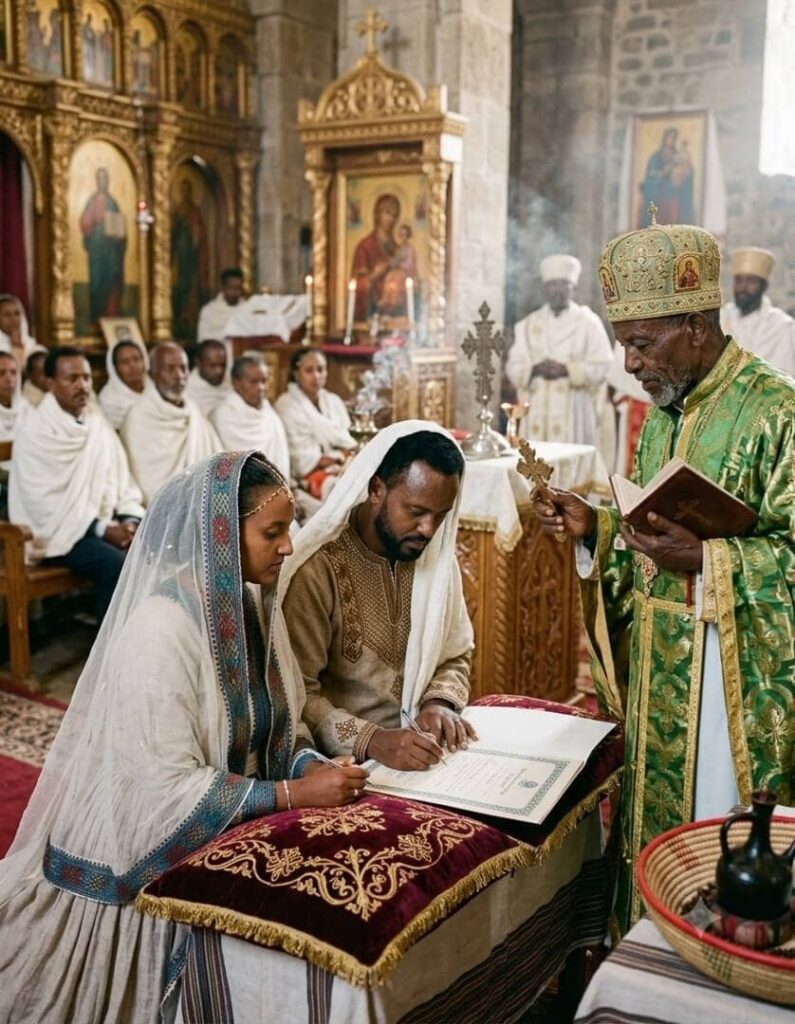
Unlike religious or customary marriages, a civil marriage is not dependent on traditions, rituals, or ceremonies performed by elders or religious leaders. A couple might still choose to have a church wedding or go through customary rites, but those alone do not automatically make the marriage legally valid unless it is also registered with civil authorities. For example, a couple may complete a beautiful Ethiopian Orthodox wedding or go through traditional family negotiations like shimagelay, but if the union is never recorded at the civil registry office, it will not be fully recognized as a legal marriage under Ethiopian law.
This is where the Federal Family Code becomes important. It is the legal framework that governs civil marriage in Ethiopia and sets out the conditions that must be met for a marriage to be valid. These include being at least 18 years old, not being currently married to someone else, and giving free and informed consent. Once these conditions are satisfied, the marriage must still go through official registration for it to have legal effect.
Civil marriage is conducted through government authorities, typically municipal or kebele-level civil status offices, depending on the location. This is where couples submit their documents, appear before the registrar, confirm their consent, and complete the legal signing process alongside witnesses. In practice, this means the legal weight of the marriage comes not from the ceremony itself, but from what happens in this official setting.
What makes civil marriage legally recognized is this structured process of verification, consent, and registration. The state does not assume a marriage exists simply because a couple has held a ceremony; it requires proof that legal conditions were met and formally recorded. So, for instance, a couple who only held a traditional celebration involving telosh and family blessings may be socially married but only become legally married once the civil registration is completed and a marriage certificate is issued.
Why Do Couples Choose Civil Marriage in Ethiopia?
Not every couple approaches marriage the same way. Some are deeply rooted in religious ceremonies or traditional customs, while others want something more direct and legally clear from the start. That’s where civil marriage becomes the practical choice. It strips everything down to what matters most in the eyes of the law: eligibility, consent, and official registration. Here’s why many couples in Ethiopia go down this path.
1. Legal simplicity
Civil marriage is often chosen because the legal path is straightforward and clearly defined under the Federal Family Code. There are no layered rituals or extended family negotiations required for the marriage to be valid in law.
In practice, a couple simply prepares the required documents, appears before a civil registrar, confirms consent, and completes registration. For example, two professionals living in Addis Ababa who want to avoid delays or extended traditional arrangements may choose civil marriage because it gives them a clear legal outcome without complications.
2. Official legal recognition
One of the biggest reasons couples choose civil marriage is that it immediately creates a legally recognized union once registration is completed. This is what gives the marriage weight in official systems.
For instance, when applying for housing, inheritance matters, or government documentation, authorities rely on the civil marriage certificate. Without it, even a socially recognized relationship may not be treated as legally binding. That is why couples often prioritize civil marriage when they want certainty in legal records.
3. Marriage certificate issuance
Civil marriage is also the most direct route to obtaining an official marriage certificate issued by the civil status office. This document is proof that the marriage has been properly registered under Ethiopian law.
A common example is couples who need documentation for banking, visa applications, or employment records. In those cases, the certificate becomes the key document that confirms the legal status of the relationship.
4. International recognition
Another important reason is international use. A civil marriage certificate is generally easier to present or authenticate for use outside Ethiopia compared to purely customary or religious unions.
For example, a couple planning to relocate abroad or apply for immigration benefits will often rely on a civil marriage certificate because it is the version most foreign authorities recognize and request during verification.
5. Mixed-faith couples
Civil marriage also provides a neutral legal basis for couples from different religious backgrounds. Since it is conducted by the state rather than a religious institution, it avoids conflicts that can arise when one ceremony does not reflect both partners’ beliefs.
For example, if one partner follows Ethiopian Orthodox Christianity and the other practices a different faith, civil marriage allows them to formalize their union without needing to choose one religious framework over another.
6. A straightforward legal process
Some couples simply prefer clarity. Civil marriage avoids uncertainty because the steps are clearly defined: submit documents, appear before the registrar, confirm consent, and register the marriage.
For example, couples who have already completed traditional ceremonies such as shimagelay or telosh may still choose a civil marriage afterward to ensure everything is legally secured. It becomes the final step that removes doubt about whether the marriage is officially valid.
@.ephratha beyond happy for my favs🤍💍 @Kukushiferaw @Abenezer Dejene #fypp#ethiopiantiktok#wedding#courtwedding#itsofficial#love ♬ original sound – Liya Gole
Legal Requirements for Civil Marriage in Ethiopia
Before a civil marriage is accepted and recorded in Ethiopia, the law sets out clear conditions that must be met under the Federal Family Code. These requirements are not just formalities; they are what make the union legally valid in the first place. Once they are satisfied, the civil registration process can move forward.
1. Minimum age requirement
• Both parties must be at least 18 years old
• This is the legal threshold for marriage in Ethiopia
The age rule is strict because the law treats 18 as the point at which a person is considered capable of making independent legal decisions. It is also a safeguard against child marriage, which is prohibited under Ethiopian law.
For example, if a 17-year-old couple tries to register a marriage, the civil registrar will not accept the application, even if both families agree. The law prioritizes legal age over personal or family arrangements.
2. Free and mutual consent
• Both individuals must willingly agree to the marriage
• Forced or pressured marriages are not allowed
Consent is one of the strongest pillars of civil marriage law in Ethiopia. The registrar must hear both parties clearly confirm that they are entering the marriage of their own free will.
In practice, this means a wedding arranged by families without the full agreement of one partner cannot be registered. For instance, if someone is pressured during a traditional arrangement like shimagelay but does not personally agree at the civil stage, the marriage cannot be finalized legally.
3. Legal capacity
• Both parties must be mentally and legally capable of marrying
This requirement ensures that each person understands the nature and consequences of marriage. The law assumes that individuals must be able to make informed decisions without legal or mental barriers.
For example, if someone is under legal guardianship due to a serious mental condition that affects decision-making, the registrar may not proceed with the marriage until legal capacity is established.
4. Marital status requirement
• Both individuals must be single, divorced, or widowed
• Polygamy is not recognized under civil marriage law
Ethiopian civil law requires that neither party is currently married to someone else. Proof is usually required through a certificate of no impediment, divorce decree, or death certificate of a former spouse.
For instance, if someone is still legally married but emotionally separated, they cannot enter a new civil marriage until the previous one is officially dissolved and documented.
5. Restrictions on close relatives
• Marriage is not allowed between close blood relatives or legal relatives
The law prohibits marriage between individuals who fall within restricted degrees of kinship. This includes close blood relatives and certain relationships created through adoption or marriage.
In practical terms, even if two people grow up in different households but are legally considered close relatives, the registrar will reject the application once the relationship is identified.
6. Witness requirement
• Civil marriages require witnesses to be officially recorded
Witnesses play a legal role in confirming that the marriage process followed proper procedure. They are not just symbolic participants.
Typically, couples are expected to present witnesses with valid identification who can confirm their identities and the legitimacy of the union. For example, if a couple arrives without the required witnesses, the registration process may be delayed until they are provided, since their presence is part of the legal validation process.
@yanet.ayenachew 26.06.2026 🤍 #civilmarriage #courthousewedding #elopement #love #ethiopian_tik_tok🇪🇹🇪🇹🇪🇹🇪🇹 ♬ Almost forgot that this was the whole point – Take my Hand Instrumental – afterlives
Documents Required for Civil Marriage in Ethiopia
Before a civil marriage can be registered in Ethiopia, couples are required to present specific documents to the civil status office for verification. These documents are what allow the registrar to confirm identity, eligibility, and legal capacity under the Federal Family Code. Without them, the process cannot move forward, even if both partners fully agree to the marriage.
Here is what you typically need:
1. Valid national ID or passport
This is the primary document used to confirm identity.
Every applicant must clearly prove who they are through an official identification document. Ethiopian citizens usually present a national ID or kebele ID, while foreign nationals use passports.
For example, a couple arriving at a civil registry office in Addis Ababa without valid ID will not be processed, even if all other conditions are met. Identity verification is the first checkpoint.
2. Birth certificate
• Used to confirm age and identity details
The birth certificate helps establish that both individuals meet the legal age requirement of 18 years. In many cases, especially for adults, alternative documents may be accepted if a birth certificate is unavailable, but some form of official age verification is always required.
3. Certificate of No Impediment or proof of single status
• Confirms that the person is legally free to marry
This document is one of the most important in the entire process. It proves that neither party is currently married to someone else.
For example, a foreign national may be required to present a Certificate of No Impediment issued by their home country and authenticated through the appropriate embassy channels. Without it, the registrar cannot confirm eligibility.
4. Divorce certificate or death certificate (if applicable)
• Required if previously married
If either partner was previously married, they must show legal proof that the marriage has ended. This could be a divorce decree or a death certificate of a former spouse.
For instance, someone who is separated but not legally divorced will not be allowed to register a new civil marriage until the divorce is officially completed and documented.
5. Passport-sized photographs
• Used for official registration records
Photographs are attached to the civil registration file and help complete the official record.
Typically, couples are asked to provide recent passport-sized photos. This becomes part of the marriage documentation stored by the civil status office.
6. Witness identification documents
• Confirms the identity of legal witnesses
Witnesses are not just present for formality; they are part of the legal record. Their identification documents are required to confirm their eligibility and identity.
For example, if a couple brings witnesses without valid IDs, the registrar may refuse to proceed until proper identification is provided.
7. Additional documents for foreigners (brief only)
• Passport
• Authenticated birth certificate
• Legalized Certificate of No Impediment
• Translated documents (Amharic required)
Foreign nationals must go through additional verification steps. Documents issued abroad often need to be authenticated by relevant authorities in the home country and the Ethiopian Ministry of Foreign Affairs and translated into Amharic before submission.
For example, a U.S. citizen may need to have their “free to marry” affidavit authenticated both in the United States and again at the Ethiopian Embassy before it is accepted in Ethiopia.
Step-by-Step Civil Marriage Process in Ethiopia
This is where everything comes together. Once couples understand the requirements and gather their documents, the process itself follows a clear legal path under the Civil Registration and Residency Services Agency, usually at a woreda or municipal civil status office. It is structured, but not complicated if you know what to expect.
Here’s how it works in real terms:
Step 1: Gather all required documents
Before anything else, both partners must prepare their documents in full. This includes IDs, proof of single status, birth certificates (if available), photos, and witness details.
For example, a couple might delay their appointment simply because one partner’s Certificate of No Impediment is still being processed or translated. Without complete documents, the process cannot move forward.
Step 2: Visit the civil registration office
Once documents are ready, the couple visits the local civil status office where the marriage will be registered. This is usually based on residence or the approved registration area.
In practice, someone living in Addis Ababa but working temporarily elsewhere may still need to register in the appropriate office tied to their residence or workplace verification.
Step 3: Submit documents for review
At this stage, officials check all documents carefully to confirm eligibility under the law.
For instance, if one partner submits an expired ID or incomplete proof of marital status, the file will be returned for correction before the process continues. This step is purely verification-focused.
Step 4: Notice and verification process
Once the documents are accepted, the registrar issues a public notice of the intended marriage. This notice is displayed for 15 consecutive days to allow any legal objections.
This is an important legal safeguard. For example, if someone is still legally married elsewhere or there is a valid dispute, a guardian or concerned party can submit an objection within the notice period. The registrar is then required to review and respond within a few days.
Step 5: Appear before the registrar
After the notice period, both partners must appear in person before the civil status registrar.
Here, they openly declare their free and informed consent to marry. Witnesses also appear and confirm the legality of the union. For example, a couple accompanied by four witnesses (two each) will have everyone formally identified and recorded.
This step is where the law ensures there is no coercion or hidden legal barrier.
Step 6: Registration and signing
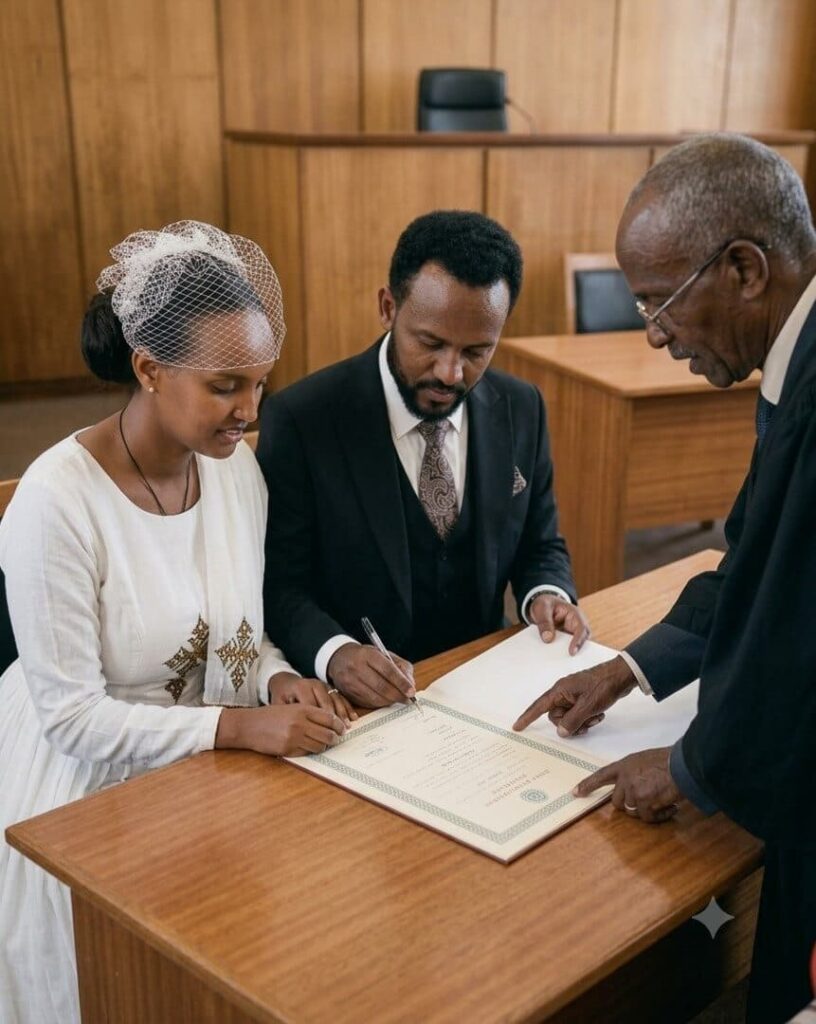
Once consent is confirmed, all parties sign the official civil marriage register—this includes the couple, the witnesses, and the registrar.
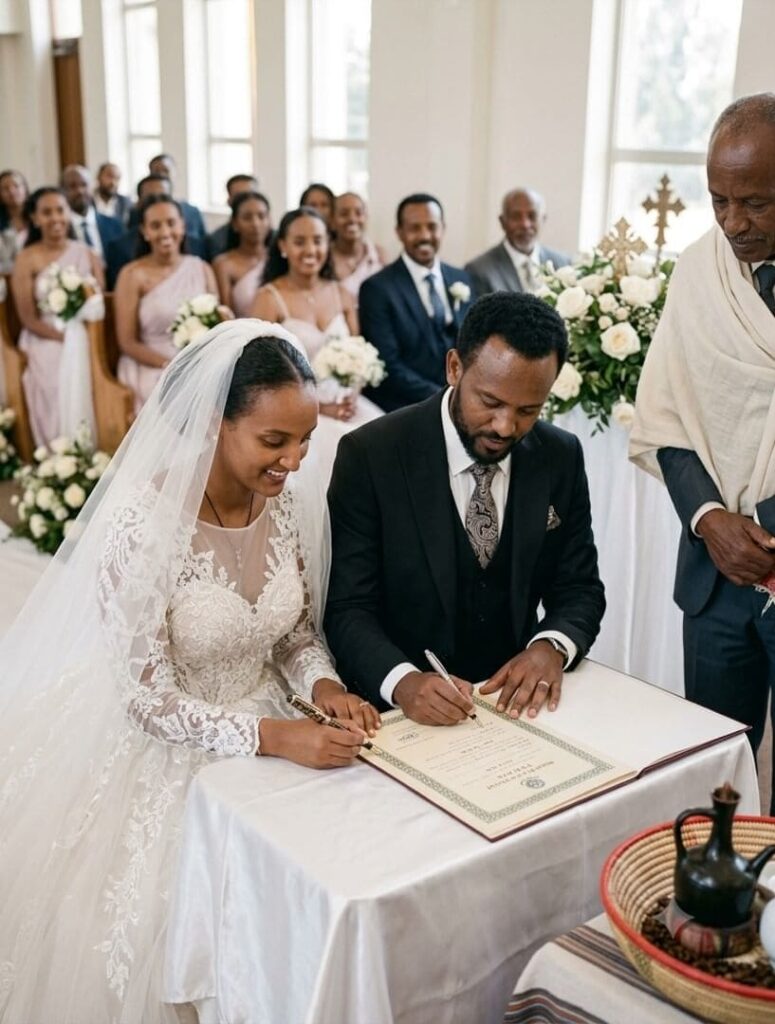
This is the legal turning point. Even if a couple had a religious or traditional ceremony earlier, it is this signature that gives the marriage full legal force under Ethiopian law.
Step 7: Receive your marriage certificate
After registration is completed, the civil status office issues an official marriage certificate.
This document is the legal proof of marriage and is often needed for banking, immigration, inheritance, and administrative purposes. For example, couples may later use it when applying for visas or updating legal records.
@hedo2025 Marriage contract signed#marriage #wedding #mustafa2022 #oromotiktok❤️💚❤️ #ethiopian_tik_tok🇪🇹🇪🇹🇪🇹🇪🇹 ♬ original sound – Medina Bargeco🧕🇪🇹🦋
How Long Does Civil Marriage Take in Ethiopia?
There’s no single fixed timeline for civil marriage in Ethiopia because the process depends on how ready the couple is and how smooth the verification stage goes. In most cases, it is not an instant process, even when everything is straightforward. The law itself builds in time to allow proper checks before a marriage is legally confirmed.
Expected timeline
In a typical smooth case, civil marriage can take a few days to several weeks.
The main reason is the legal notice period. Once documents are accepted, the registrar issues a public notice of the intended marriage, which is displayed for 15 consecutive days. This waiting period is mandatory and allows any objections to be raised before the marriage is finalized.
For example, a couple who submits complete documents in Addis Ababa with no issues may still wait two to three weeks before completing registration simply because the notice period must run its full course.
Delays in the process
Delays usually happen when something is incomplete or unclear in the application.
A common example is when one partner forgets to bring properly authenticated proof of single status or when photographs or IDs do not match the submitted details. In such cases, the process pauses until corrections are made.
Some couples also underestimate how long it takes to prepare foreign documents. For instance, a foreign national waiting for embassy authentication or translation into Amharic may experience additional delays before even reaching the registration stage.
Missing documentation
Missing paperwork is one of the most common reasons civil marriages take longer than expected.
If even one key document is missing—such as a divorce certificate, passport copy, or witness identification—the registrar will not proceed with verification. The file is typically returned until everything is complete.
For example, a couple may arrive fully prepared except for one witness ID. Instead of moving forward, they are asked to return once all witness documents are available, which can push the timeline back by several days or more.
Verification and objection issues
Even after documents are accepted, the verification stage can affect timing.
During the 15-day notice period, the marriage is open to legal objections. If someone raises a concern—such as an existing marriage, identity issue, or legal dispute—the registrar must investigate and resolve it before proceeding.
For instance, if a third party claims one partner is already legally married elsewhere, the process pauses while authorities verify records. Only after the issue is resolved can the marriage continue.
The simple reality
In practice, a civil marriage in Ethiopia moves quickly when everything is properly prepared, but it slows down when legal checks, document issues, or verification steps come into play. The system is designed this way on purpose: to ensure that every marriage registered is legally valid and fully confirmed before the certificate is issued.
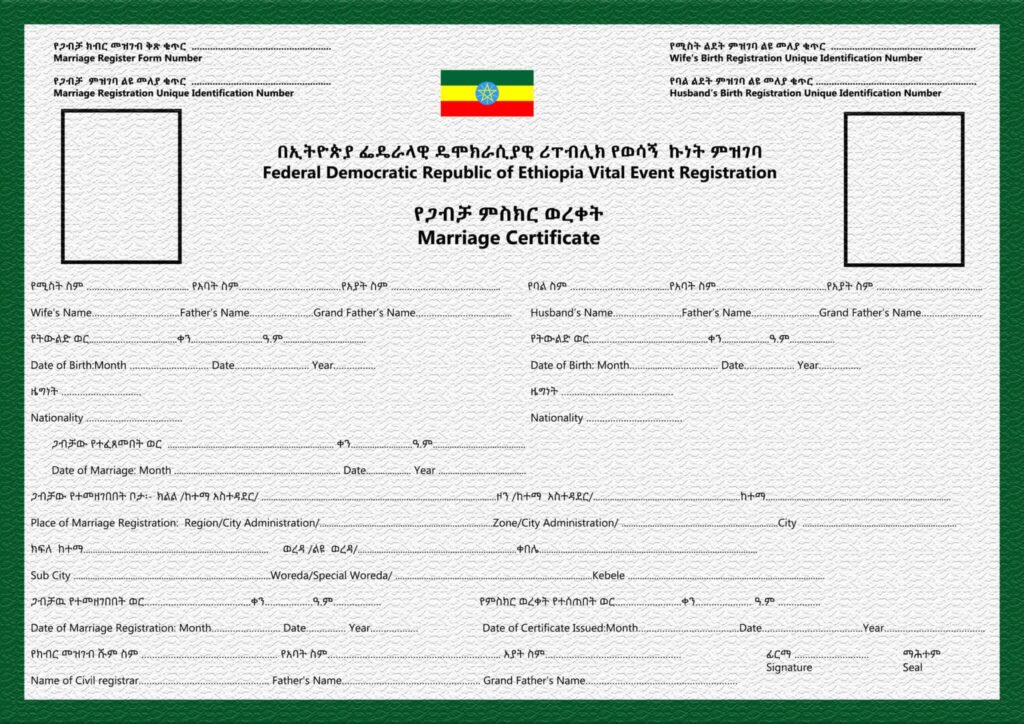
Ethiopian Civil Marriage Certificate
Once a civil marriage is completed in Ethiopia, the most important outcome is the official marriage certificate. This document is what turns the process into legal proof. It is issued under the civil registration system and serves as the state’s confirmation that the marriage has been properly recorded.
What is a civil marriage certificate?
A civil marriage certificate is an official legal document issued by the civil status office after a marriage has been registered. It confirms that both individuals met the legal requirements—age, consent, and documentation—and that the marriage was properly recorded under the Federal Family Code.
In simple terms, it is the paper that proves your marriage exists in the eyes of the law, not just in a ceremony or family setting.
For example, a couple who had a traditional wedding ceremony months earlier will only be considered legally married when this certificate is issued after civil registration.
When is it issued?
The certificate is issued after all legal steps are completed, including document verification, the public notice period, witness confirmation, and official signing in the civil register.
In most cases, once the registrar finalizes the signing stage, the certificate is provided shortly after. For instance, after a couple signs the civil register with their witnesses, the office processes and issues the certificate as the final legal confirmation of the marriage.
Why is it important?
The civil marriage certificate is not just a formality. It is the primary legal proof of marriage in Ethiopia and is often required in many official situations.
Here are some real-life uses:
- Passport applications: A spouse may need it to update marital status or apply for family-related documentation.
- Immigration processes: It is commonly required when applying for visas or residency through a spouse abroad.
- Property ownership: It may be used when jointly registering or inheriting property.
- Family and legal matters: Courts and government offices rely on it for inheritance, custody, or legal recognition of spousal rights.
For example, if a couple applies for a dependent visa abroad, the embassy will not rely on a wedding ceremony or family confirmation—they will request the official civil marriage certificate.
Can you get a replacement if it is lost?
Yes. If a civil marriage certificate is lost or damaged, couples can request a replacement from the civil registration office where the marriage was originally recorded.
The process usually involves identity verification and a search of the official civil register. For example, a couple who lost their certificate during relocation can apply for a reissued copy after confirming their records in the system.
This ensures that even if the physical document is lost, the legal record of the marriage remains intact in the government registry.
@boutros_naol Marriage Certificate #boutros #ethiopian_tik_tok🇪🇹🇪🇹🇪🇹🇪🇹 #lawschool #ethiopian_tik_tok #viralvideos #creatorsearchinsights ♬ Powerful songs like action movie music – Tansa
Common Mistakes Couples Make During Civil Marriage Registration
Most delays and frustrations in civil marriage registration in Ethiopia don’t come from the law itself. They come from simple, avoidable mistakes couples make when preparing or showing up at the civil registration office. Here are the ones that show up most often.
- Missing documents
One of the most common issues is arriving without a complete file. The office will not proceed if even one key document is missing, whether it’s an ID, proof of single status, or divorce papers if someone was previously married.
For example, a couple might show up ready for registration, only to be turned back because the Certificate of No Impediment hasn’t been legalized or translated properly.
- Wrong information on forms
Small errors like mismatched names, incorrect birth dates, or inconsistent spellings across documents can pause the entire process. The registrar has to verify everything before proceeding.
A typical case is when someone’s name appears differently on their ID and birth certificate, which forces a correction request before the marriage can move forward.
- Delaying registration too long
Some couples assume they can complete everything in one visit or wait until after their ceremony. In reality, civil registration follows a structured process that includes notice periods and verification steps.
For instance, couples who plan a quick wedding event first often realize later that the legal registration still has to go through the required waiting and verification stages before they are officially recognized.
- Assuming the ceremony alone makes the marriage legal
A big misunderstanding is thinking a religious or traditional ceremony automatically creates a legal marriage. In Ethiopia, that’s not enough on its own.
A couple might have a full church or customary wedding with family celebrations, but without civil registration, the law does not treat the marriage as officially valid.
- Ignoring witness requirements
Witnesses are not optional in civil marriage registration. They must be present, properly identified, and able to sign the register.
There are cases where couples arrive with only one or two witnesses, expecting to “sort it out later,” only to have the process postponed until the full requirement is met.
If anything, this part of the process is less about complexity and more about preparation. Most problems disappear once couples know exactly what the office expects before they walk in.
Frequently Asked Questions
Is civil marriage legal in Ethiopia?
Yes. Civil marriage is fully legal in Ethiopia and is governed by the Federal Family Code. Once it is properly registered with the civil status office, it is legally recognized across the country.
Is civil marriage the same as court marriage in Ethiopia?
Yes, in practice, they refer to the same thing. A “court marriage” usually describes a marriage conducted before a civil status registrar under government authority.
How many witnesses are needed?
Typically, four witnesses are required—two for each partner. They must be adults with valid identification and must be present during the registration and signing process.
Can foreigners have a civil marriage in Ethiopia?
Yes. Foreigners can marry in Ethiopia, but they must provide additional documents such as a valid passport, a Certificate of No Impediment, and properly authenticated and translated documents where necessary.
How long does it take to get a marriage certificate?
It varies depending on the notice and verification process. In many cases, the certificate is issued shortly after the signing is completed, but the full process may take a few weeks due to the mandatory notice period and checks.
Can I register a religious marriage as a civil marriage?
Yes, but only if it is officially registered with the civil status office. A religious ceremony alone is not enough. The marriage only becomes legally valid once it is recorded by the government.
Final Thoughts
Civil marriage in Ethiopia is straightforward on paper, but it only works smoothly when the legal steps are taken seriously from the start. It’s not just about showing up at an office or having a ceremony; it’s about meeting the conditions that make the union legally valid.
What really matters is following the process the way the law sets it out: age, consent, documentation, witnesses, and proper registration. Once those pieces are in place, the marriage becomes officially recognized and backed by the civil status system.
Before moving forward, it always helps to double-check the requirements with the relevant civil registration office. A bit of preparation upfront saves time later and makes sure the marriage is not only meaningful but also legally secure from day one.