Bride price and dowry in Ethiopia vary across ethnic groups and communities. From a groom’s first visit to family negotiations and traditional exchanges, here’s how the process usually unfolds.
Marriage in Ethiopia doesn’t exist in isolation. It sits inside a broader cultural framework shaped by long-standing customs, family involvement, and community expectations. To really understand it, you have to place it within the wider world of weddings in Ethiopia and the traditions and customs that guide how unions are formed across different communities.
This is also why bride price and dowry can’t be looked at separately from the rest of the system. In Ethiopia, and across many African societies, these practices are not just financial exchanges. They are part of how marriages are recognized, how families formally connect, and how respect is shown when two lineages come together.
In many cases, these ideas appear in different forms depending on the type of marriage being practiced. Whether it’s customary marriages shaped by local traditions, or Christian marriages such as those in the Ethiopian Orthodox Tewahedo Church, the role of family agreement and cultural approval remains central. The details change, but the underlying structure stays familiar.
At the heart of it, bride price and dowry are less about payment and more about meaning. In some families, the groom’s side presents gifts as a gesture of respect and commitment. In others, the bride’s family contributes support to help establish the new household. These practices are not uniform, and they are not applied the same way everywhere, but they consistently reflect the idea that marriage is something negotiated and acknowledged between families, not just individuals.
Across Africa, similar systems exist in different forms, from livestock-based traditions in some regions to cash or symbolic gifts in others. Ethiopia fits into this broader picture while maintaining its own variations shaped by ethnicity, religion, and local custom.
Understanding Bride Price and Dowry in Ethiopia
This is where things start to get clearer, because in Ethiopia, the terms “bride price” and “dowry” are often used loosely, sometimes even as if they mean the same thing. In practice, they don’t. And once you look closely, you realize they sit on opposite sides of how families structure marriage agreements.
Ethiopia doesn’t follow a single national system for these exchanges. What happens in one community can look completely different in another. In some regions, especially among groups like the Oromo, what people refer to as “bride price” is more common, where the groom’s family presents cattle, money, or other valued items to the bride’s family as part of the marriage agreement. It’s less about “buying” and more about showing respect, readiness, and formal commitment between families.
In other communities, especially in parts of the north, like among the Tigray, the structure leans more toward dowry, where the bride’s family contributes support to help the couple start their new household. That can include money, household goods, or other forms of assistance. Again, it’s not a universal rule, and even within the same ethnic group, families can approach it differently depending on circumstance.
What ties both systems together is intention. These are not rigid commercial transactions. They are negotiated arrangements shaped during family meetings, often starting with Shimagelay visits and followed by longer discussions where elders guide expectations on both sides. Telosh and other gift exchanges later on often reflect what was agreed during those early conversations.
In many modern urban families, the meaning has shifted even further. The exchange is often symbolic now, with less focus on exact material value and more emphasis on gesture, agreement, and family recognition. What remains constant is the role these practices play in confirming that two families are now connected through marriage, not just two individuals.
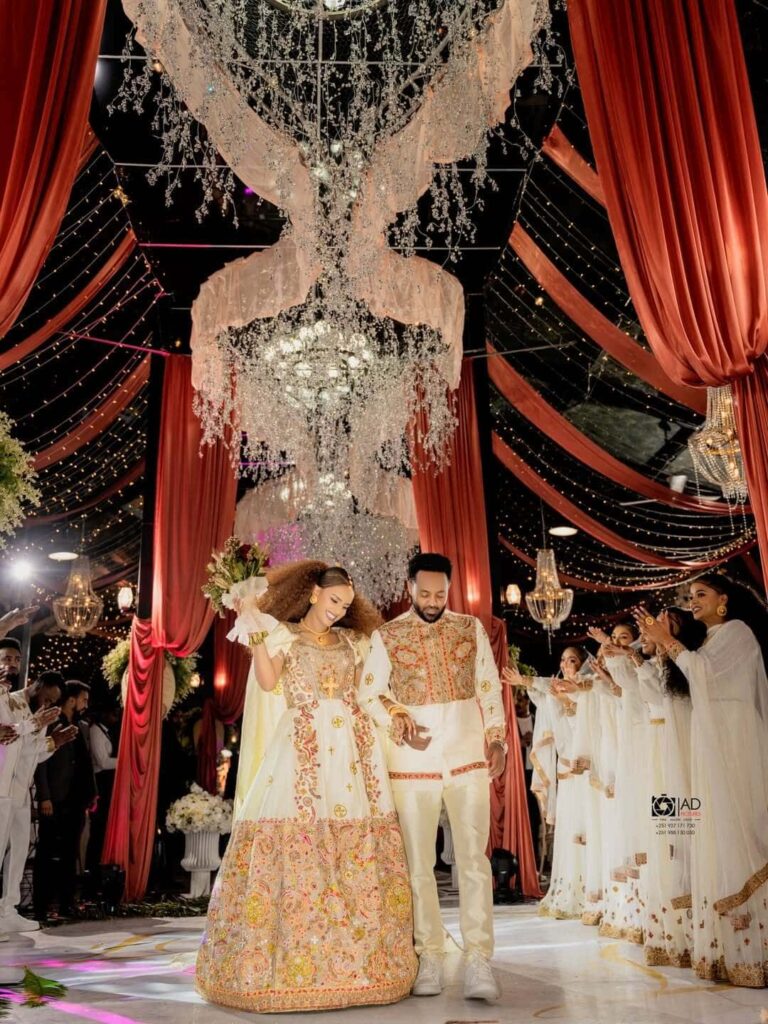
How Dowry Works in Ethiopia
Dowry in Ethiopia is rarely a fixed package with clear rules. It is shaped through discussion, memory of past customs, and what both families consider fair in their specific context. That’s why even within the same ethnic group, two families can approach it differently depending on their means, values, and how they understand marriage itself. In many cases, it is less about “payment” and more about support for a new household and recognition of the union.
The process usually begins at the first Shimagelay visit, when elders from the groom’s family arrive at the bride’s home. At this stage, nothing is priced or itemized. The focus is still on introductions, intentions, and character. But once both families acknowledge the possibility of marriage, the conversation slowly shifts. Elders begin to outline expectations, and what starts as a general discussion gradually becomes a quiet negotiation about what support will be given and how both sides will contribute.
What is expected on the bride’s side varies widely across Ethiopia’s major communities. Among the Tigray, dowry is more clearly defined and often includes money, property, or household items meant to help the couple establish their home. In Oromo communities, the conversation is more likely to revolve around negotiated contributions alongside broader family agreements, often influenced by elders who mediate what is appropriate. Among the Amhara, especially in many rural settings, formal dowry exchanges are less rigid, with families instead leaning toward shared support or pooling resources for the couple. In some southern pastoralist groups, wealth may be expressed in livestock or other traditional assets, reflecting how value is understood in those communities.
These differences come from how each society is structured. Where livestock is central to life, agreements naturally reflect cattle, goats, or sheep. Where cash economies are stronger, contributions shift toward money and household essentials. In urban settings, the picture changes again, with families often focusing more on practical setup items or symbolic support rather than large traditional transfers. Even then, elders remain the ones who guide the tone of the discussion, deciding what feels balanced and culturally respectful.
Across all these variations, one thing stays consistent: dowry is not enforced by law or rigid tradition. It is built through agreement. Families adjust it based on circumstance, education, and economic reality, which is why these discussions can stretch over time instead of being settled in a single sitting.
By the end, what looks like a financial arrangement is actually something quieter and more social. It is a negotiated understanding between two families about how a marriage begins and what kind of support will hold it together.
Bride Price in Ethiopia: Does It Exist?
One of the most misunderstood parts of Ethiopian marriage traditions is the idea of bride price. In most communities, what people casually call “bride price” is not a simple payment or purchase. It is closer to a set of symbolic exchanges between families, shaped by agreement and tradition rather than fixed rules. Even when gifts are involved, they usually sit within a wider process of respect, approval, and alliance-building between two households.
The clearest moment where this becomes visible is Telosh. By this stage, negotiations have already happened during Shimagelay and follow-up discussions, so what takes place now is confirmation rather than bargaining. The groom’s family arrives at the bride’s home with gifts that were already agreed upon earlier. These can include clothing, jewelry, perfumes, household items, and, in some rural settings, livestock such as sheep or cattle. In more urban families, the exchange often leans toward practical or symbolic items, but the meaning stays the same: showing readiness and commitment.
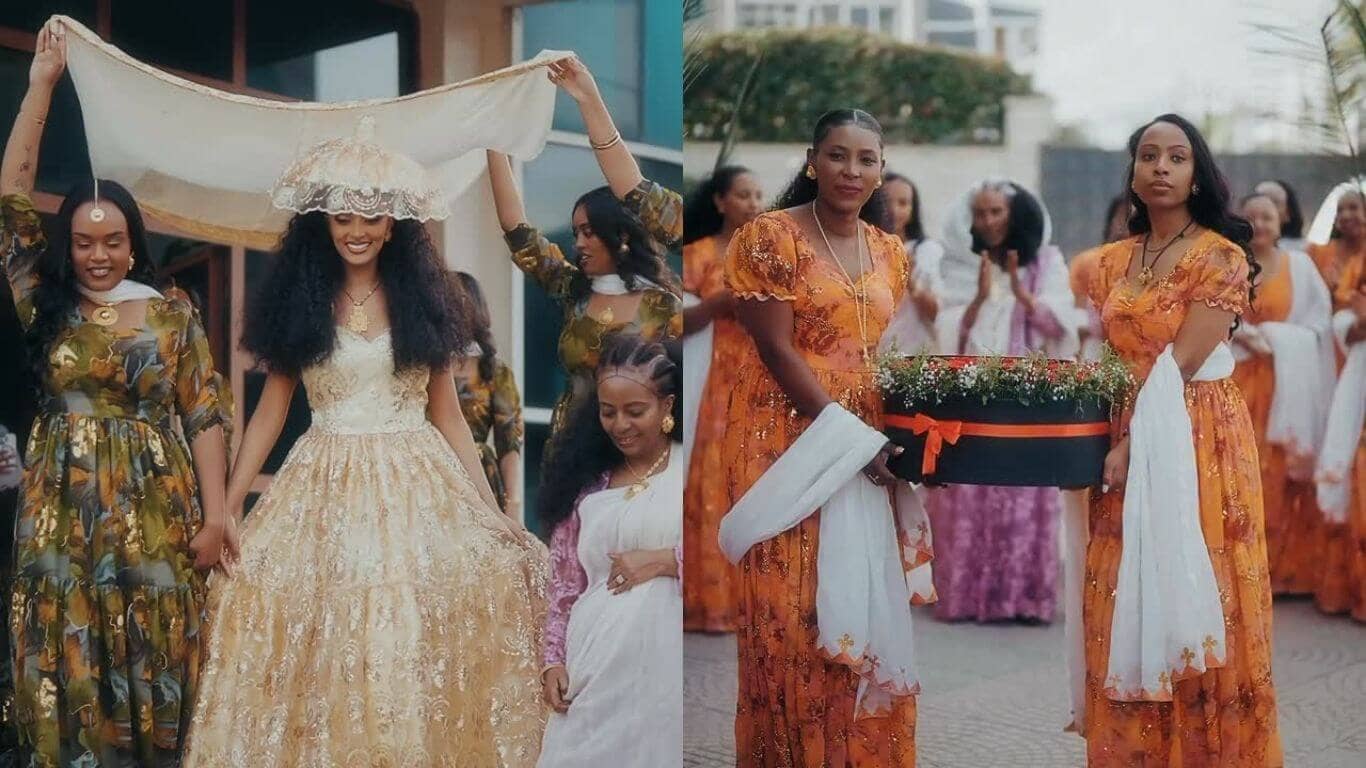
Unlike earlier stages, the bride is usually present at Telosh, along with both families. The atmosphere shifts into something closer to a celebration. There is music, shared food, coffee rituals, and a lot of interaction between the two sides. Gifts are presented publicly, often followed by applause, laughter, and light teasing between families. Guests may also bring small items of their own, adding to the sense that this is a shared milestone rather than a private arrangement.
Across Ethiopia’s major communities, the meaning of this moment changes slightly, but the idea behind it stays consistent. Among Oromo families, what looks like bride price is typically part of a broader negotiated exchange, often involving cattle or cash as a sign of agreement and respect. In southern pastoralist groups, livestock-based contributions are more prominent and closely tied to social status and tradition. In Amhara communities, formal bride price systems are generally absent, with families focusing more on mutual understanding than material exchange. Among the Tigray, dowry traditions are more visible, shifting the flow of support toward the couple’s new household instead of the bride’s family receiving goods.
Even with these differences, the important thing is this: it is not about “buying” a bride. It is about families publicly recognizing a union and confirming that both sides are ready to support it. The exchange of gifts is simply the language different communities use to express that agreement.
@christinegashaw this day was a representation of God’s love. Next up: engagement party 🤭 @Osayi_ #wedding #ethiopian #nigerian #love #culture #engagement ♬ Dance With You – Alex Jean
The Role of Elders in Negotiation
In Ethiopian marriage traditions, elders are not background characters. They are the ones who carry the process forward. From the very first step of Shimagelay, when they enter the bride’s home on behalf of the groom’s family, they set the tone for everything that follows. They speak, explain, ask, listen, and sometimes pause long enough for silence to do its work. The couple may be at the center of the relationship, but the process itself moves through the hands of their families.
Shimagelay is where this begins. Elders arrive not as guests but as representatives, opening a formal conversation between two families that may not have spoken before. What follows is careful and structured. The groom’s background is presented, intentions are explained, and the bride’s family responds in their own way. In many homes, there is coffee, sometimes food, and always a sense that what is happening carries weight beyond the room. Nothing is rushed. Even when everyone is in agreement in principle, families often pause, return later, and continue the discussion over multiple visits.
That pattern continues into the negotiation stage. Agreement in Ethiopian weddings is rarely reached in a single sitting. It develops slowly, shaped by repeated conversations, reflection, and the guidance of elders on both sides. The tone matters as much as the content. Respect is non-negotiable, timing is everything, and even silence can signal understanding. Humor sometimes appears, too, not to lighten the seriousness, but to keep relationships intact while difficult topics are discussed. In many cases, what looks like negotiation from the outside is actually a long process of reading each other’s intentions.
Across different communities, the structure changes slightly, but the role of elders stays consistent. Among Oromo, Amhara, and Tigray families, elders often determine how formal or extended the process becomes. In some Muslim households, religious leaders may join early discussions, adding spiritual guidance alongside cultural negotiation. In pastoralist and southern communities, elders may also help interpret expectations around livestock or symbolic contributions, making sure both families understand what is being agreed upon in local terms.
One detail that rarely changes is the absence of the bride in these early stages. These conversations are handled between families because marriage is treated as a collective responsibility before it becomes a personal celebration. The idea is not exclusion, but structure. Elders act as protectors of the process, making sure emotions, pride, and misunderstanding don’t derail something that is meant to unite two families.
By the time an agreement is reached, it rarely feels like a single decision. It feels more like something that has gradually become obvious. That is the quiet strength of elders in Ethiopian weddings. They don’t force outcomes. They guide them until both sides recognize that they have already reached one.
Modern Shifts in Bride Price and Dowry in Ethiopia
What used to be a heavily structured family negotiation has not disappeared, but it has definitely changed shape. In cities, especially, the system has adjusted to new economic realities, education, and the way young people now choose partners. The core ideas remain, but how they are practiced looks very different from rural or older traditions.
- Cash replacing livestock
In many urban families, cattle or goats are no longer central to agreements. Cash or practical contributions have taken their place, mainly because they are easier to manage in city life and fit modern economies. - Ceremonial rentals instead of full purchases
Weddings in cities like Addis Ababa can be expensive. To reduce costs, some families rent ceremonial items that would traditionally be bought new, especially for gift presentations or wedding setups. - Less arranged marriage, more personal choice
Couples today are more likely to choose each other first, with families stepping in later to approve or bless the union rather than arrange it from the beginning. - Symbolic exchanges over strict negotiations
What used to feel like detailed bargaining is now often simplified into symbolic gestures. Families focus more on respect and agreement than on exact material value. - Gifts are shifting toward the couple
Instead of items going mainly to parents, many modern ceremonies now direct gifts to the couple themselves, helping them start their new life together. - Blending civil, religious, and traditional systems
It’s increasingly common for couples to combine civil registration, church or mosque ceremonies, and traditional family rituals into one wedding journey. - Smaller, less intensive negotiations in some urban homes
Extended multi-visit negotiations still exist, but in many urban settings, they are shorter, less formal, and more flexible depending on the families involved. - Influence of education, migration, and global exposure
Exposure to different cultures and economic realities has shifted expectations. Many families now prioritize practicality alongside tradition. - Elders are still present, but with a lighter role
Even in modern setups, elders are not absent. They are still respected voices but often act more as advisors and symbolic approvers than strict negotiators.
Even with all these changes, the deeper idea hasn’t disappeared. Marriage is still treated as something that connects families, not just individuals. What has changed is the form it takes, not the meaning behind it.
Final Thoughts
Marriage in Ethiopia still carries a strong family presence, even as modern life reshapes how it is practiced. Whether in rural communities or urban centers, it is rarely just about two people coming together. Families remain involved from the beginning to the end, shaping decisions and giving the union its social weight.
Bride price and dowry are not fixed systems with one definition. They shift depending on region, culture, religion, and even the economic reality of the families involved. What one community treats as a formal exchange, another may approach as symbolic support or skip entirely.
Across all these differences, a few things stay consistent: respect between families, guided negotiation, and the importance of approval on both sides. Every community expresses it in its own way, but the underlying idea remains the same. Marriage is understood as the joining of families, not just individuals, and that is what continues to hold the tradition together.