Getting married in Uganda as a foreigner goes beyond the celebration. Understanding the legal process, requirements, and how citizenship works will help you navigate everything with clarity from the start.
Uganda has quietly become one of those places where weddings feel deeply personal and rooted in meaning. From vibrant family gatherings to ceremonies shaped by long-standing Ugandan wedding traditions and customs, it’s not just about two people getting married; it’s about families coming together. Whether it’s locals celebrating at home or foreigners choosing weddings in Uganda as their destination, the experience often goes beyond what many expect.
For foreigners, marrying in Uganda can take different forms. Some come to marry Ugandan partners and fully embrace the culture, including traditional steps like the Kukyala ceremony and the more formal Kwanjula ceremony. Others simply choose Uganda as the setting for their wedding, drawn by the atmosphere, people, and sense of community that surrounds these celebrations.
But here’s the part many people overlook. Marriage in Uganda isn’t just a cultural experience; it’s also a legal process. No matter how beautiful or elaborate the ceremony is, what ultimately matters is whether it meets the legal requirements and is properly recognized.
That’s where clarity becomes important. Before thinking about citizenship, paperwork, or long-term plans, you need to understand how marriage works legally in Uganda and what it takes for it to be valid in the first place.

Can Foreigners Marry in Uganda?
Yes, foreigners can legally marry in Uganda. There’s no special restriction stopping you just because you’re not a citizen. What matters is meeting the basic legal conditions that apply to everyone, being of legal age, entering the marriage willingly, and not already in a subsisting monogamous union.
The form the marriage takes is also flexible. You can go the civil route through a registrar, have a church or mosque ceremony, or follow a traditional path that includes cultural processes like the Kwanjula ceremony. Each option is valid, as long as it’s conducted properly and registered according to the law.
So the real question isn’t whether you can marry in Uganda; it’s how you choose to do it. And that choice matters, because the type of marriage you go with will shape the requirements, the process, and even what comes next legally.
Types of Marriage Available to Foreigners in Uganda
Once you’ve established that you can legally marry in Uganda, the next step is choosing how. The country recognizes several types of marriage, and as a foreigner, you’re not limited to just one option.
- Civil marriage
Conducted by the government through the National Identification and Registration Authority, this is the most straightforward legal route. It’s formal, strictly monogamous, and widely used by foreigners. - Church / Christian marriage
Held in licensed places of worship, these ceremonies follow Christian rites and are also monogamous. They must be registered to be legally recognised. - Islamic marriage
Conducted under Islamic law, usually through a recognised mosque or authority. Depending on the circumstances, it may allow polygamy. - Customary marriage
Rooted in tradition, this involves cultural practices, family participation, and ceremonies like the Kwanjula ceremony. It is legally recognised but must be registered to carry full legal weight.
Here’s the key thing most people miss:
Some marriages in Uganda are strictly monogamous (civil and church), while others can be potentially polygamous (customary and Islamic). That distinction matters legally, especially when you start thinking about rights, obligations, or even citizenship later on.
And regardless of the type you choose, one rule cuts across all of them: proper registration is what makes the marriage fully recognised in the eyes of the law.
If you want a deeper breakdown of how each one works, when to choose which, and what they involve culturally and legally, check out our full guide on types of marriages in Uganda.

Legal Requirements for Foreigners Getting Married in Uganda
Before anything becomes official, there are a few non-negotiables you need to meet. These are the basics that determine whether your marriage will actually be recognised under Ugandan law.
Basic legal conditions
- You must be at least 18 years old
- Both parties must freely consent to the marriage
- You cannot already be in a subsisting monogamous marriage
- You must not be closely related (prohibited degrees of kinship)
Once those are in place, it comes down to documentation. This is where most delays usually happen, especially for foreigners who assume the process is automatic.
Required documents for foreigners
- Valid passport
- Valid visa or proof of lawful entry into Uganda
- Certificate of No Impediment (a document from your home country confirming you’re free to marry)
- Registered marriage affidavits
- Passport-size photographs
- A letter from the Local Council (LC1) confirming you’ve lived in the area for at least 15 days
- Two adult witnesses with valid identification
If you were previously married
- Divorce decree (if divorced)
- Death certificate (if widowed)
It’s worth getting these documents right from the start. Missing even one can slow things down or push your timeline further than expected.
Once everything is in place, the next step is straightforward: you move into the actual marriage process.
Marriage Process in Uganda for Foreigners (Step-by-Step)
Once your documents are sorted, the process itself is fairly structured. It doesn’t feel complicated when you understand the flow, but skipping steps or rushing things is where problems usually start.
Civil marriage (most common for foreigners)
This is the most straightforward route if you want a clean, legally recognised process.
- Submit a notice of marriage through the registrar (handled by the National Identification and Registration Authority)
- The notice is displayed publicly for 21 days
- If no objections are raised, you’re cleared to proceed
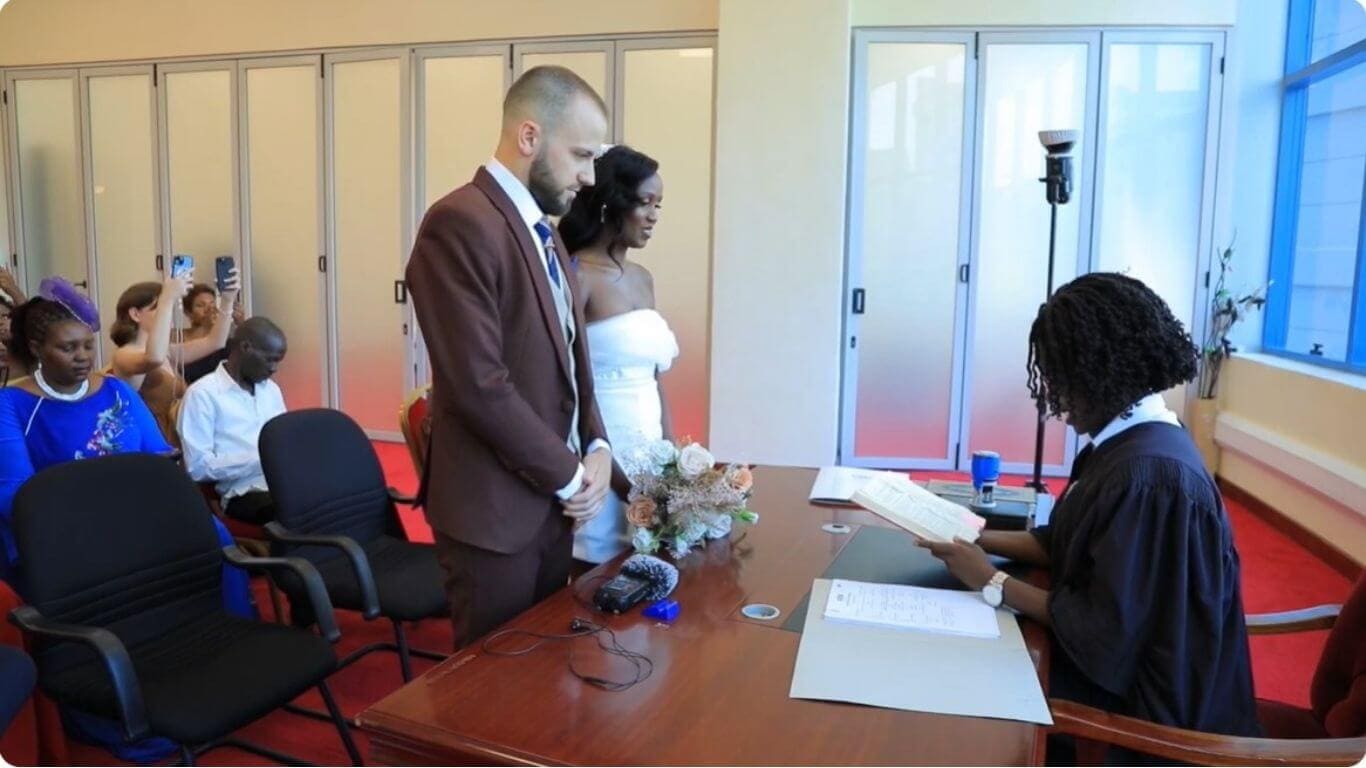
- The ceremony takes place at the registrar’s office
- You sign the documents, and your marriage certificate is issued
It’s simple, but that 21-day window is mandatory unless you’re granted a special exemption.
Religious marriage
If you’re going through a church or mosque, the process follows a slightly different path.
- Meet the specific requirements set by the church or mosque
- Some churches will publish banns (announcing your intent to marry)
- The ceremony is conducted by a licensed officiant
- Afterward, the marriage is filed and registered with NIRA
The ceremony may feel more personal or spiritual, but the legal side still has to be completed for it to count officially.
Customary marriage
This is where culture takes centre stage.
- The marriage follows traditional practices, often including the Kwanjula ceremony
- Families are heavily involved, and gift exchanges or bride price may be part of the process
- After the ceremony, the marriage should be registered with the local authorities
Many foreigners experience this route when marrying into a Ugandan family. It’s rich in meaning, but like every other type, it only carries full legal weight once it’s properly registered.
Once the ceremony is done, one thing matters more than anything else: getting your marriage certificate. That’s what makes everything official moving forward.

Marriage Certificate in Uganda (Why It Matters)
Once your marriage has been properly conducted and registered, the next thing you receive is your marriage certificate. This isn’t just a formality; it’s the document that proves your marriage legally exists.
It becomes important almost immediately. You’ll need it for things like immigration processes, updating official records, banking, property matters, and any situation where your marital status has to be verified. Without it, even a fully completed ceremony can be difficult to prove in legal or administrative settings.
If you’re thinking long term, especially around residency or citizenship, this document becomes even more critical. It’s one of the key pieces of evidence required to show that your marriage is valid and recognised under Ugandan law. Certificates are issued and can be verified through the National Identification and Registration Authority, so it’s always worth making sure yours is properly recorded.
And that leads to the question most people are really trying to answer: Can that marriage actually lead to Ugandan citizenship?
Can a Foreigner Get Ugandan Citizenship by Marriage?
Yes, a foreigner can become a Ugandan citizen through marriage, but it doesn’t happen automatically. It falls under what’s known as citizenship by registration, which means you have to formally apply and go through the legal process.
The key condition is that your marriage must be valid, legally recognised, and still active. In simple terms, it has to be a real, ongoing union with a Ugandan citizen, not just a ceremony on paper. In most cases, authorities also expect the marriage to have lasted for a minimum period before you can apply, usually around three years.
So while marriage can open the door, it doesn’t instantly change your citizenship status. It simply gives you the right to apply, and then your case is assessed based on the law and supporting documents.
Requirements for Ugandan Citizenship by Marriage
This is where things become more formal. Marriage alone doesn’t automatically change your citizenship status. You still have to qualify, apply, and be assessed by the immigration authorities through the Directorate of Citizenship and Immigration Control.
At the core, citizenship by marriage is only considered if you’ve been legally married to a Ugandan citizen for a sustained period, usually at least three years, and you’ve been living in the country legally during that time. From there, the process shifts heavily into documentation and verification.
Core requirements
- Valid Ugandan marriage certificate certified by the National Identification and Registration Authority (NIRA/URSB records)
- Proof that your spouse is a Ugandan citizen (national ID or passport copy)
- Evidence that the marriage is genuine and ongoing (not for immigration convenience)
- Police clearance report from your home country or Interpol
- Valid passport with at least 6 months’ validity
- Current immigration status (work permit, dependant pass, student pass, or residence permit)
- Passport-size photographs
- Local Council (LC1) recommendation from your area of residence
- Medical report from a recognised health facility
- Consent from your Ugandan spouse
- Cover letter from the applicant
- Birth certificate (especially if children are involved)
In some cases, the board may also request that both partners appear in person for verification.
How the application process works (in practice)
The application is handled through the immigration portal under the Directorate of Citizenship and Immigration Control, and it follows a structured online process:
- Create and submit an online application
- Accept the terms and select the correct category (citizenship by marriage)
- Fill in the full application form
- Upload all supporting documents (an application ID is generated for tracking)
- Pay the required fee (about USD 2000)
- Wait for review and approval
- Attend a biometric capture at the immigration office if required
Once approved, the applicant is issued official documentation confirming citizenship status, depending on the category granted (temporary or long-term status, such as 5 years, 10 years, or life in certain cases).
Key clarity
This process is not automatic, and it’s not guaranteed. Even if you meet the marriage requirement, approval depends on verification, documentation, and compliance with immigration law.
So while marriage opens the door to citizenship, the decision still sits with the immigration board, not the relationship alone.
How the Citizenship Process Works (Simple Breakdown)
Once you’ve submitted your application, the process moves into a verification stage. This is where everything you provided is carefully checked to confirm that your marriage, identity, and legal status are in order.
- You submit your application through the immigration system
- Authorities carry out background checks on your documents and history
- The application is reviewed by the relevant government bodies
- A final decision is made — either approval or rejection
Behind the scenes, this isn’t just paperwork. Officials are essentially confirming that the marriage is genuine, legally valid, and meets the conditions required under immigration law.
One important thing to keep in mind: citizenship through marriage is not automatic. Even if you meet all the requirements, it is still a decision made by the authorities after review.
Dual Citizenship in Uganda
Dual citizenship is allowed in Uganda, which is important for many foreigners thinking long-term. What this means in practice is simple: you can hold Ugandan citizenship while still keeping the citizenship of your home country, as long as your country of origin also permits it.
The process isn’t automatic just because you got married. It still requires a formal application and approval from the relevant authorities. But the key advantage is flexibility — you don’t always have to give up your original passport to become Ugandan.
That said, approval depends on meeting the full legal requirements and proving genuine eligibility. Marriage can open the door, but it doesn’t remove the need to go through the proper citizenship process from start to finish.
Important Legal Rules Foreigners Should Know
This is where people usually get caught off guard, so it helps to be clear from the start.
Civil and church marriages in Uganda are strictly monogamous. You’re expected to be legally committed to one partner, and the system treats anything outside that as invalid.
Customary and Islamic marriages work differently in some cases and may allow more than one spouse, depending on the legal and cultural framework being applied. But even there, everything still has to follow the law.
What you cannot do is mix systems or ignore the rules. Bigamy is a criminal offence, and trying to be married in more than one legally monogamous union at the same time can land you in serious trouble.
On top of that, registration isn’t optional if you want legal recognition. And marriages entered just for immigration benefits or with false documentation can be challenged, rejected, or even lead to loss of status later on.
Cultural Reality: Marrying a Ugandan
Marriage in Uganda doesn’t really start on the wedding day. For many families, it begins much earlier with introductions and traditional visits like the kukyala ceremony, where families formally meet and acknowledge the relationship.
From there, cultural expectations often come into play. Bride price is still a common part of many communities, and it’s usually handled between families as a sign of respect rather than a transaction. The details vary depending on culture, but the meaning behind it is broadly consistent.
What stands out most is how family-centred the whole process is. It’s rarely just about two people. Decisions, blessings, and even the tone of the wedding tend to involve both sides of the family in a very active way.
Cost of Marriage in Uganda for Foreigners
Costs vary depending on the type of marriage and how formal you go with the process, but there are some clear baseline figures worth knowing.
For civil marriages, foreigners typically pay higher fees than locals. The standard civil marriage fee is around USD 210 when both parties are foreigners, and about UGX 260,000 when one party is Ugandan or a refugee. On top of that, there are small additional charges like certificate processing or certified copies.
Documentation costs also come into play. Things like affidavits, translations, passport photos, and the certificate of no impediment can add extra expenses depending on where you get them done, especially if documents need legalisation or embassy support.
Church or mosque weddings don’t usually have fixed government fees, but they often involve administrative contributions to the place of worship, depending on the institution and how formal the ceremony is planned.
Then there are optional costs that people sometimes forget. These include special venue approvals if you want to marry outside a licensed place or requests that waive standard notice periods, which can cost around UGX 300,000 depending on the case.
Timeline: From Marriage to Citizenship
This part is really about managing expectations, because people often assume it’s fast or automatic. It’s not.
From the point you submit a civil marriage notice, you’re looking at a minimum waiting period of about 21 days before anything can proceed. That’s the legal window where objections can be raised or cleared.
Before that even starts, there’s usually preparation time — getting documents in order, confirming eligibility, and aligning schedules. For most people, that stage alone can take a few weeks, depending on how organised everything is.
The citizenship side is a completely different timeline. Even after a legal marriage, citizenship is not immediate. It’s a longer-term process measured in years, not months, and it only begins to make sense once the marriage is valid, stable, and properly recognised.
Common Mistakes to Avoid
A lot of the problems people run into with marriage in Uganda don’t come from big issues. They come from small, avoidable mistakes that slow everything down.
One of the most common is showing up with incomplete paperwork. Something as simple as a missing passport copy or an unclear status document can delay the entire process.
Another big one is skipping the certificate of no impediment. Without it, especially for foreigners, the system has no formal proof that you’re legally free to marry, and that alone can stall approval.
Some couples also assume that once the ceremony is done, everything is automatically recognised. That’s not how it works. If the marriage isn’t properly registered, it can create problems later with legal rights, immigration, or even proof of status.
And then there’s the biggest misconception of all: thinking marriage automatically leads to citizenship. It doesn’t. It may support an application, but citizenship is still a separate legal process with its own checks and approvals.
Finally, people sometimes ignore that different marriage types follow different rules. What applies in a civil marriage doesn’t always apply in a customary or religious one, and mixing expectations is where confusion usually starts.
Final Thoughts
Marriage in Uganda is not complicated once you understand how the system works. Most of the confusion people face comes from skipping steps or assuming things happen automatically, when in reality, everything follows a clear legal process.
Citizenship is possible through marriage, but it doesn’t come bundled with the wedding. It’s a separate application with its own requirements, checks, and timelines that continue long after the ceremony is over.
When you follow the right process from the beginning, things stay smooth. Your marriage is properly recognised, your documents are in order, and your legal standing in the country is protected without unnecessary stress later on.